

A Seven-Surface 12×24 Stacked-Lay Tile Package in Alberta Avenue
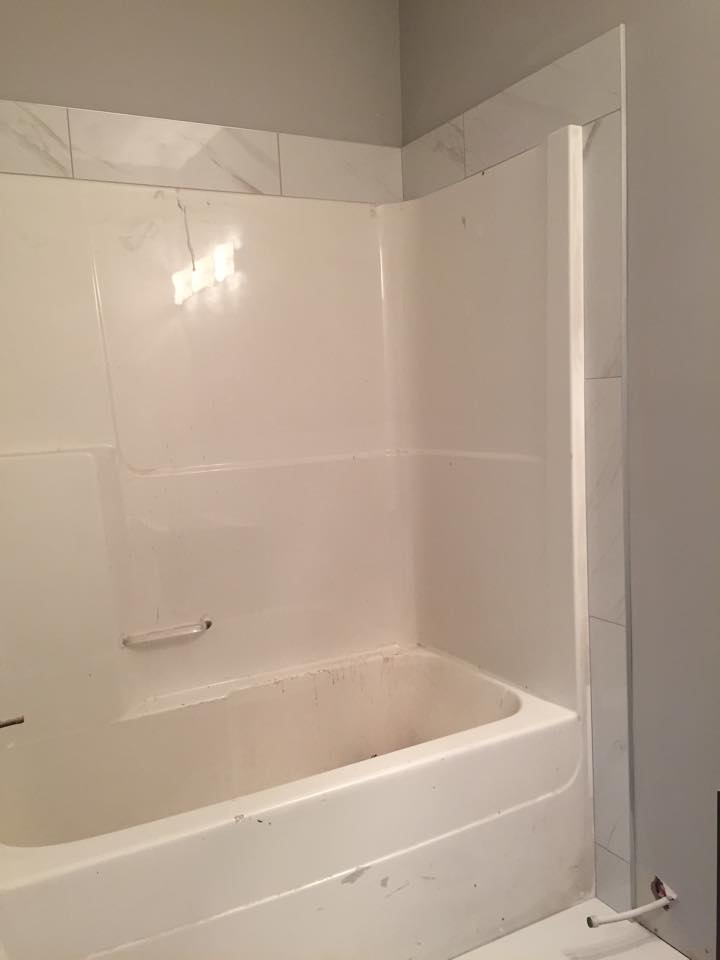
Alberta Avenue is one of Edmonton’s oldest central residential corridors, running along 118 Avenue between 82 Street and 124 Street, with a housing stock that runs from early-1900s character homes through mid-century builds and contemporary infills filling in demolished lots. New builds in Alberta Avenue are infill projects sitting alongside heritage neighbours, which means the build spec has to deliver a contemporary tile package without reading as out of scale with the surrounding character architecture. On this Alberta Avenue new build The Tile Experts ran a seven-surface tile scope: three shower or tub surrounds, three bathroom floors, and a laundry floor, all in a 12 by 24 porcelain installed in a stacked pattern, with VersaBond Mortar on every wall surface and 253 Gold Laticrete Mortar on every floor surface, all grouted with Prism Grout.
Why a Seven-Surface Single-Tile Package Is the Right Alberta Avenue Move
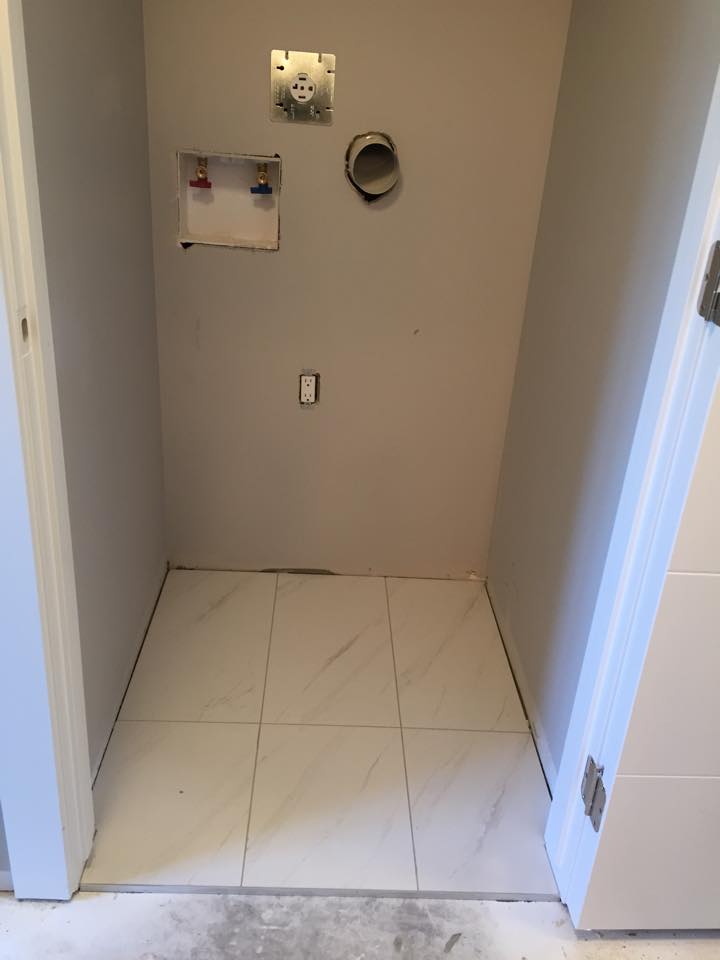
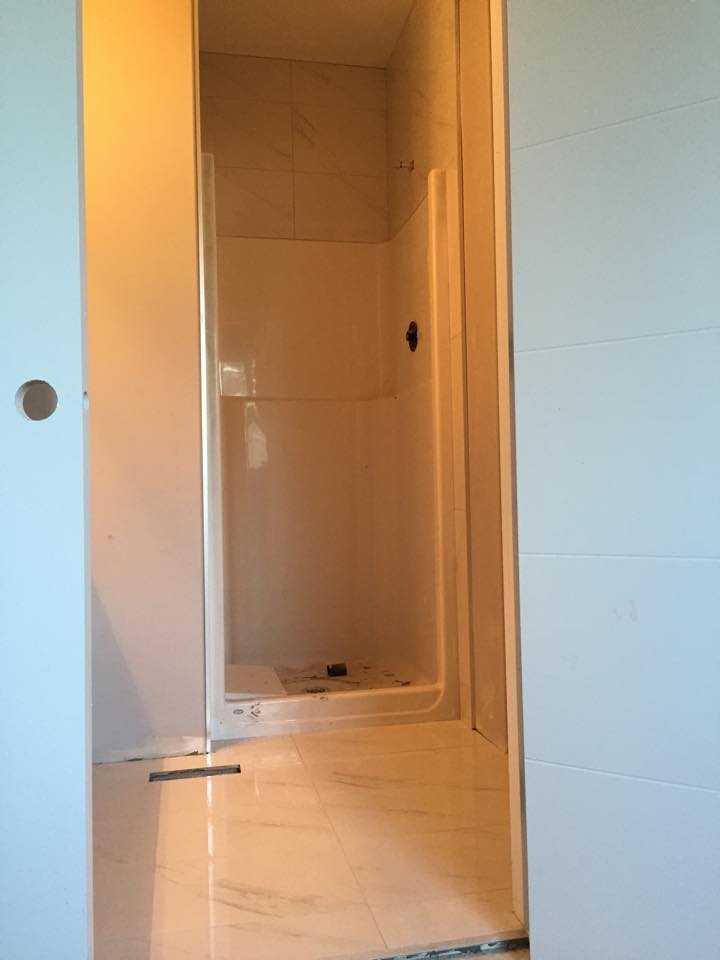
The build runs the same 12 by 24 porcelain across seven distinct surfaces in the house: three shower or tub surrounds in three different bathrooms, three bathroom floors, and a laundry floor. Why one tile across seven surfaces: the single-tile strategy produces a continuous-material reading across every tiled zone in the home, where the eye registers the build as one designed package rather than as a stitched assembly of seven separate decisions. On a new build where prospective buyers, family members, and visitors walk through the home and form an impression of the design intent, the continuous tile reading is one of the most legible signals that the build was specified with intent. Why this matters on an Alberta Avenue infill specifically: infill builds in established neighbourhoods compete with both new-build production communities (which typically deliver a multi-tile package with different tiles per room) and with heritage homes (which typically have either dated tile or no tile at all). A single-tile package across seven surfaces signals a level of design coordination that separates the infill from both comparisons. The format choice: the 12 by 24 is the right format for a multi-surface single-tile package because it works at residential proportions across every surface type, from the narrower geometry of a tub surround to the larger plan area of a laundry floor. A smaller tile (like a 12 by 12) would have read as busier across the larger floor surfaces, and a larger tile (like a 24 by 24) would have read as oversized on the tub surround walls. The 12 by 24 holds across all seven surfaces. The pattern: a stacked lay across every surface produces a continuous joint grid that connects from wall to wall, wall to floor, and room to room at every transition. The result is a tile package that reads as one calibrated assembly.

Why a Stacked Lay Across Walls and Floors
The pattern across every one of the seven surfaces is a stacked lay, with every tile positioned directly above the tile below and every joint aligning into a grid of squares (technically rectangles, repeating every 12 by 24 unit). What a stacked lay delivers visually: the most contemporary tile pattern available and the one that reads cleanest at premium-finish levels. The aligned joints create an architectural grid that connects with the geometry of contemporary cabinetry, plumbing fixtures, and modern interior lines. Why a stacked lay rather than a brick lay or staggered lay: a brick lay (50 percent offset) reads as traditional and was the dominant pattern across mid-century tile work, while a 70/30 staggered lay reads as a compromise between traditional and contemporary. The stacked lay commits the install to a fully contemporary design language and is the right call on a new build aimed at a contemporary architectural reading. Why the same stacked lay across walls and floors: running the stacked lay on both surfaces produces a continuous grid that connects from horizontal to vertical at the base of every wet-zone surface (showers, tub surrounds), where the floor joint lines align with the wall joint lines at the perimeter. The continuity at every wall-floor transition is one of the highest-value details in a multi-surface tile package, and it is the move that separates a coordinated install from a production-grade install. The lippage discipline: a stacked lay on a 12 by 24 is the most lippage-sensitive pattern available, because every joint corner aligns with the corner of the adjacent tile and any high or low edge reads immediately against the aligned grid. Across seven surfaces with full stacked alignment, the install requires careful substrate flatness preparation on every surface plus disciplined back-buttering on every tile.
Why VersaBond on the Walls and 253 Gold on the Floors
The bond coat split on this build is VersaBond on every wall surface (the three tub or shower surrounds) and 253 Gold Laticrete on every floor surface (the three bathroom floors plus the laundry floor). What VersaBond delivers on the walls: a polymer-modified portland-cement thinset rated for interior wall and floor applications, with the bond strength to carry the 12 by 24 tile on residential vertical surfaces and the polymer chemistry that handles the splash-zone moisture environment of tub and shower surrounds. The chemistry is rated for residential wet-zone walls and is the right call when the install is a conventional tub or shower surround without a Schluter Kerdi or other dedicated waterproofing membrane behind the tile. What 253 Gold delivers on the floors: a polymer-modified medium-bed thinset specifically engineered for large-format tile, with the slump-resistance to maintain bond coat thickness under the 12 by 24 footprint without producing centre voids. Why this matters on the floors: a 12 by 24 tile has a plan area of two square feet, and the bond coat under each tile has to support that full plan area without slumping. A standard thinset can slump under the 12 by 24 footprint and produce centre voids that show up over time as tile rocking or cracked grout joints. 253 Gold over a properly prepared substrate produces a fully load-rated floor assembly that handles the warranty life of the install. Why the split makes sense: matching the bond coat chemistry to the surface environment and tile format produces a fully load-rated assembly in every zone. The walls get the wall-rated VersaBond, and the floors get the floor-rated 253 Gold, with both chemistries grouted continuously with Prism.
Planning a seven-surface single-tile new-build package with a 12 by 24 stacked-lay specification, coordinated wall and floor bond coats, and a continuous Prism grout finish in Alberta Avenue or anywhere in central Edmonton? Call The Tile Experts at 587-333-9800 or request a quote.
Alberta Avenue New Build FAQ
How much does a seven-surface single-tile new-build package cost in Alberta Avenue?
For a project of this scope (12 by 24 porcelain in a stacked lay across three shower or tub surrounds, three bathroom floors, and a laundry floor, VersaBond on every wall, 253 Gold Laticrete on every floor, full Prism grout finish), plan on 14,500 to 24,000 dollars in tile-scope labour and material, with total square footage across the seven surfaces as the primary cost driver.
Why run the same tile across seven different surfaces instead of varying it by room?
The single-tile strategy produces a continuous-material reading across every tiled zone in the home, where the eye registers the build as one designed package rather than seven separate decisions. On an infill build in an established neighbourhood, the continuous reading is one of the strongest signals that the spec was coordinated with intent.
Why does the floor require 253 Gold Laticrete instead of standard VersaBond?
A 12 by 24 has a plan area of two square feet, and the bond coat under each tile has to support that full plan area without slumping. 253 Gold is the medium-bed chemistry that maintains bond coat thickness across the larger footprint and produces a fully load-rated floor. Standard thinset can slump and produce voids over time. See our floor tile installation service.
Tile Installation in Alberta Avenue and Central Edmonton
Alberta Avenue runs along 118 Avenue between 82 Street and 124 Street, with neighbours in Westwood, Eastwood, Parkdale, Norwood, and the broader north-central character residential market. Seven-surface single-tile new-build packages, stacked-lay 12 by 24 installations, and coordinated wall and floor bond coat strategies are some of the most common projects in this central infill corridor where new builds compete with both established production communities and heritage homes. The Tile Experts install bathrooms, kitchens, floors, custom showers, fireplaces, and feature walls across Alberta Avenue, Westwood, Eastwood, Parkdale, Norwood, and the rest of central Edmonton, plus the full capital region. Contact us or call 587-333-9800 for a free in-home walkthrough.
More Projects in Alberta Avenue and the Edmonton Area
Explore more recent tile installation work by The Tile Experts.