

A Mosaic Kitchen Backsplash and Two Random-Staggered Bathrooms With Waterfall Inserts in Wellington
Wellington is an established north Edmonton residential neighbourhood east of 127 Street and south of 153 Avenue, with a housing stock that runs from late-1970s and 1980s family homes now well into their second renovation cycle. Wellington renovations typically tackle three rooms at once (a kitchen backsplash plus two bathrooms), because the original 1970s and 1980s tile in those rooms has aged out of every contemporary design language, and the homeowners want a coordinated refresh across the wet-zones and the kitchen rather than three separate projects. On this Wellington renovation The Tile Experts ran exactly that scope: a mosaic kitchen backsplash set with ReliaBond Tile Adhesive, plus two bathrooms in a random staggered pattern with waterfall mosaic insert features set with VersaBond Mortar, all grouted with Prism Grout.
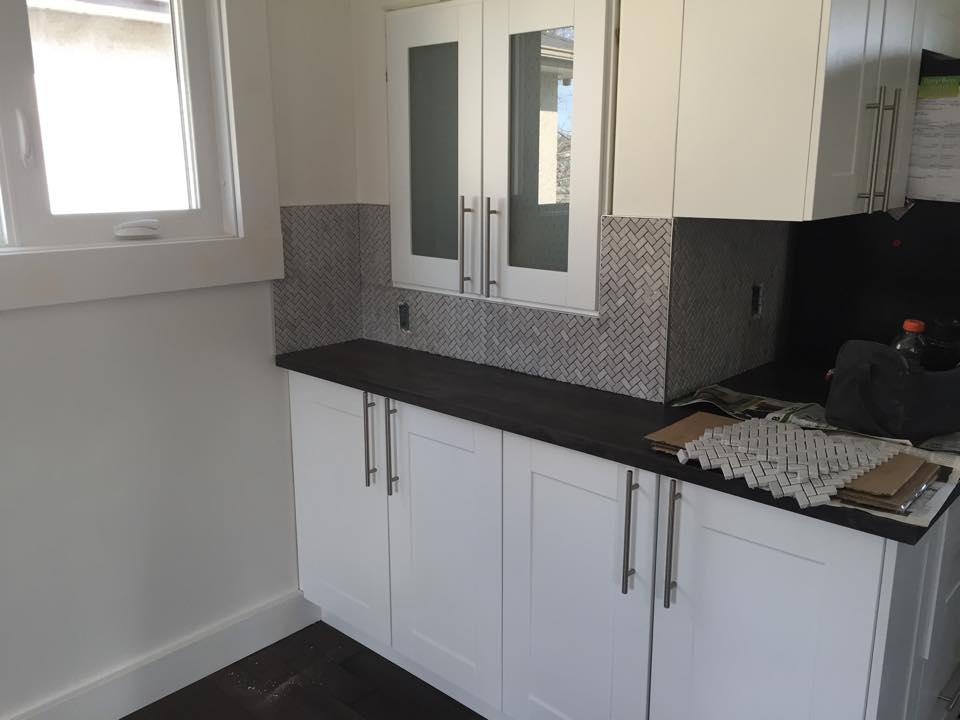
Why a Mosaic Kitchen Backsplash Is the Right Wellington Renovation Move
The kitchen backsplash on this renovation is a mosaic tile install across the full backsplash run, set with ReliaBond and grouted with Prism. What a mosaic backsplash delivers: a continuous textured surface across the backsplash run rather than a grid of larger field tiles, with the small format producing a denser visual texture that catches light from overhead and under-cabinet fixtures across more facets per square foot than any larger format. Why a mosaic on a Wellington renovation specifically: Wellington kitchens in this vintage typically have cabinetry from the 1980s or 1990s that has either been refaced or replaced during the renovation, and the new cabinetry tends toward simpler shaker or slab fronts in neutral colours. A mosaic backsplash adds the textural complexity that the simpler cabinetry intentionally avoids, balancing the kitchen design without committing it to a specific colour-statement language. Why a mosaic rather than a 3 by 6 subway: a 3 by 6 subway is the safer renovation move, but a mosaic is the more design-deliberate move. On a renovation that is replacing aged-out tile work, the mosaic signals that the homeowners are not just refreshing the kitchen but resetting it with current design intent. The mosaic format also reads as more contemporary than the subway, which matters when the goal of the renovation is to bring the kitchen forward by 30 years rather than to recreate an earlier style. The bond coat: the mosaic was set with ReliaBond, the Type 1 organic mastic rated for interior dry-zone vertical wall applications. The immediate grab and generous open time of the mastic match the install workflow of a mosaic backsplash, where the small format means the bond coat has to set across many tile edges per square foot. The grout: the backsplash was grouted with Prism, which holds its colour reading across years of kitchen moisture and grease exposure.
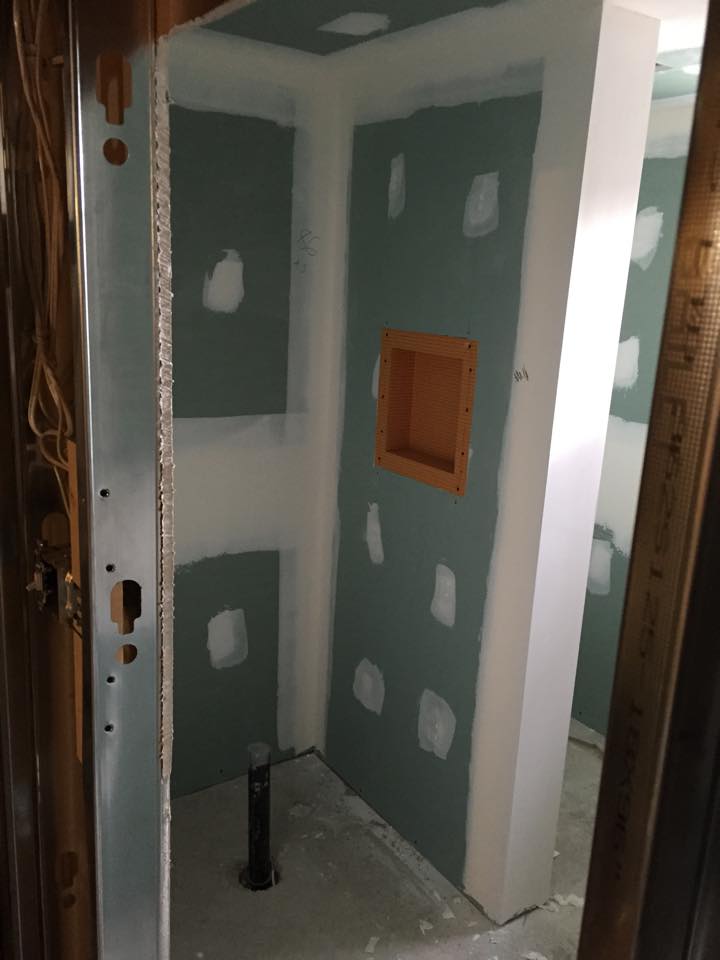
Why a Random Staggered Pattern in the Bathrooms
The two bathrooms on this renovation are tiled in a random staggered pattern. What a random staggered pattern means: the tiles are laid so that every course is offset from the course above and below by a varying amount, with the offset percentage changing from one course to the next rather than holding to a fixed 50 percent or 70/30 pattern. The result is a soft staggered reading that does not produce the regular stepped pattern of a fixed-offset brick lay, but also does not produce the aligned grid of a stacked lay. Why a random stagger on a Wellington bathroom renovation: a random staggered pattern reads as more relaxed than a stacked lay and more contemporary than a 50 percent brick lay. On a residential bathroom that is being renovated rather than newly built, the random stagger matches the renovation context (where the goal is a fresh, comfortable reading rather than an architectural statement), and it is the pattern that holds its reading best across small bathroom geometry where the wall surface area is limited and a fixed-offset pattern would produce only a few repeats before the wall ends. Why the same pattern across both bathrooms: running the same random stagger across both bathrooms produces a coordinated reading between the two rooms, where a guest walking from one bathroom to the other registers them as part of the same renovation rather than as two separate projects. The renovation context rewards coordination, because the design discipline that signals quality is consistency across rooms rather than variation. The bond coat: both bathrooms were set with VersaBond, the polymer-modified thinset rated for interior wall and floor applications, with the bond strength and polymer chemistry that handle the residential wet-zone environment of bathroom walls without dedicated waterproofing membranes behind the tile.
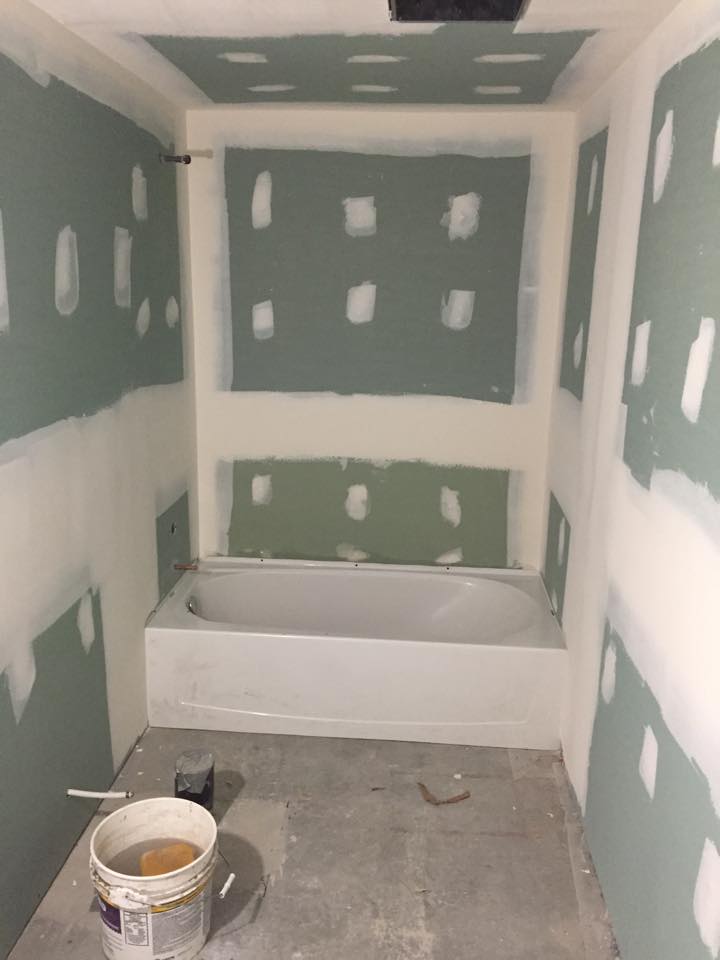
The Waterfall Mosaic Insert Across Both Bathrooms
The design hook across both bathrooms is a waterfall mosaic insert, a vertical band of mosaic tile running floor-to-ceiling on one wall in each shower or tub surround. What a waterfall mosaic insert is: a vertical column of small-format mosaic tile running from the floor or tub deck up to the ceiling or the underside of the wall return, positioned on the back wall or a sidewall as a single design moment. The vertical orientation references a waterfall, with the mosaic facets catching light and reading as a textured vertical surface against the calmer random-staggered field. Why a vertical insert on a random-staggered field: the random stagger reads as a soft horizontal-dominant pattern (because the staggering happens course by course in horizontal bands), and a vertical waterfall provides a deliberate counterpoint that breaks the horizontal reading and adds a vertical accent. A horizontal accent band (like a 6 inch insert at a fixed elevation) would have reinforced the horizontal reading of the staggered field and produced a busier wall, while the vertical waterfall is the cleaner contrast. Why the same waterfall in both bathrooms: running the same waterfall design across both bathrooms produces the coordinated reading that the renovation context rewards, with both rooms sharing the same design hook in the same orientation. The bond coat for the mosaic: the mosaic waterfall in each bathroom was set with the same VersaBond as the surrounding field, with the chemistry held continuous across the format transition. The grout: the joints across the field and the waterfall were grouted with Prism, continuous with the rest of the bathroom and with the kitchen backsplash. The continuous grout chemistry across all three rooms produces a uniform joint colour reading and signals the renovation as one coordinated scope.
Planning a three-room renovation with a mosaic kitchen backsplash and two random-staggered bathrooms with waterfall inserts in Wellington or anywhere in north Edmonton? Call The Tile Experts at 587-333-9800 or request a quote.

Wellington Renovation FAQ
How much does a three-room renovation with a mosaic kitchen backsplash and two random-staggered bathrooms with waterfall inserts cost in Wellington?
For a project of this scope (mosaic kitchen backsplash set with ReliaBond, two bathrooms in a random staggered pattern with waterfall mosaic inserts set with VersaBond, full Prism grout finish across all three rooms), plan on 11,500 to 18,500 dollars in tile-scope labour and material, with total bathroom wall and floor square footage and backsplash linear footage as the primary cost drivers.
Why use a random staggered pattern instead of a 50 percent brick lay or a stacked lay?
A random staggered pattern reads as more relaxed than a stacked lay and more contemporary than a 50 percent brick lay. On a residential bathroom renovation where the goal is a fresh, comfortable reading rather than an architectural statement, the random stagger holds its reading best across the small bathroom geometry.
Why does the kitchen backsplash use ReliaBond while the bathrooms use VersaBond?
The kitchen backsplash sits in a dry-zone vertical wall environment, where the Type 1 organic mastic of ReliaBond provides the immediate grab and generous open time that match the mosaic install workflow. The bathrooms sit in residential wet-zone environments, where the polymer-modified thinset chemistry of VersaBond is the right specification. See our kitchen backsplash service.
Tile Installation in Wellington and North Edmonton
Wellington sits east of 127 Street and south of 153 Avenue, with neighbours in Lorelei, Beaumaris, Carlisle, Caernarvon, and the broader north Edmonton mature residential market. Three-room renovations with coordinated kitchen and bathroom tile work, random-staggered patterns, and waterfall mosaic insert details are some of the most common projects in this 1970s and 1980s housing market now in its second renovation cycle. The Tile Experts install bathrooms, kitchens, floors, custom showers, fireplaces, and feature walls across Wellington, Lorelei, Beaumaris, Carlisle, Caernarvon, and the rest of north Edmonton, plus the full capital region. Contact us or call 587-333-9800 for a free in-home walkthrough.
More Projects in Wellington and the Edmonton Area
Explore more recent tile installation work by The Tile Experts.