

An Open-Plan Main-Floor 12×12 Tile Install Across Kitchen, Dining, Entrance, Pantry, and Hallway in Beaumont
Beaumont new builds in the 2010s and 2020s have shifted strongly toward open-plan main floors where the kitchen, dining area, entrance, pantry, and hallway are not separate rooms but one continuous floor zone, often running 600 to 900 square feet as a single uninterrupted surface. Tile across an open-plan main floor is one of the most demanding floor scopes in residential tile work, not because the tile itself is complicated but because the line-setting (the geometric layout that decides where every cut falls along every wall, doorway, transition, and cabinet kick) determines whether the finished floor reads as professional or as a compromise. On this Beaumont new build The Tile Experts laid 12 by 12 porcelain in a straight lay across the entire open-plan main floor (kitchen, dining, entrance, pantry, hallway), with a line-setting strategy that eliminated small cuts at every wall, doorway, and cabinet face, and grouted the floor with Prism Grout.
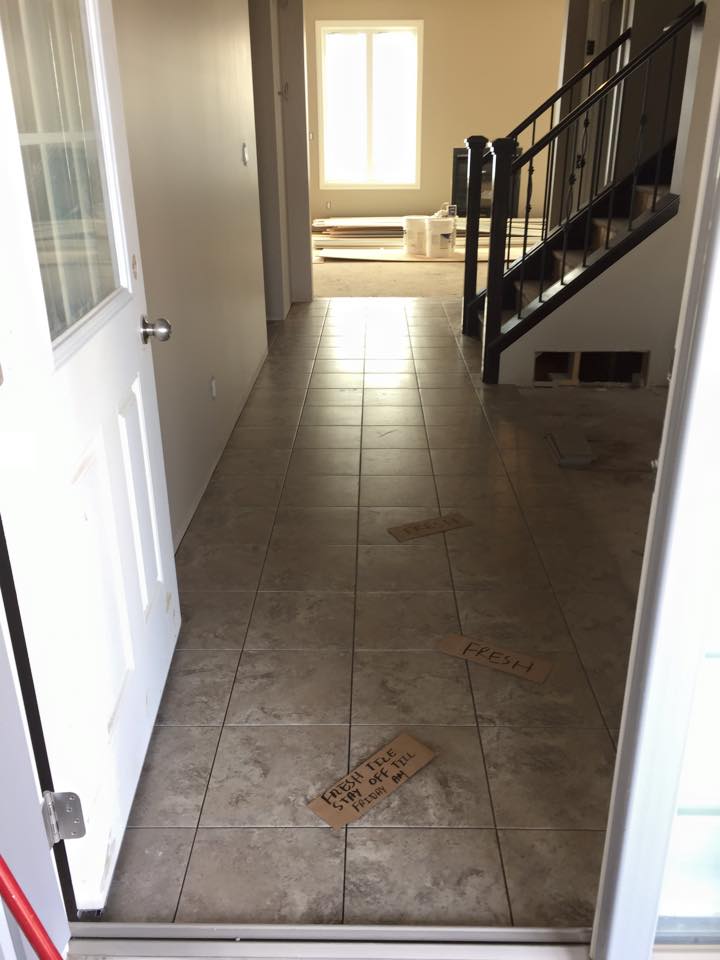
Why Line-Setting Is the Hardest Part of an Open-Plan Tile Floor
The single most consequential decision on a large open-plan tile floor is where the layout lines run, because every wall, doorway, cabinet kick, and transition gets its cuts determined by that decision before the first tile goes down. What line-setting actually involves: measuring the full perimeter of every room in the open-plan zone, identifying every wall, doorway, cabinet face, and transition that the tile will meet, and then choosing the two perpendicular reference lines that the entire field will be laid against. The reference lines decide where the centre of the field falls, which decides how the field rows align across each room, which decides what size cut lands against every wall, doorway, and cabinet face. Why small cuts at the perimeter are the failure mode to avoid: if the layout produces a sliver cut against any wall (less than roughly half a tile width), the finished floor reads as compromised, because the eye registers the sliver as evidence that the layout was driven by convenience rather than design. The principle we work to: no less than half a piece of tile against any wall or visible transition. Why this is harder on an open-plan floor than on a single room: a single-room floor only has to balance the line-setting against one set of walls. An open-plan floor running through five connected zones has to balance the layout against five sets of walls, plus every doorway transition, plus every cabinet face in the kitchen, plus every appliance kick, plus the pantry threshold. Moving the layout to fix a small cut at one wall can introduce a small cut at a different wall, and the trade-offs have to be resolved before the first tile is set. What the resolution looks like on this build: after measuring the full open-plan footprint, we chose reference lines that landed at least half a piece of tile against every visible wall, doorway, cabinet face, and transition in the kitchen, dining, entrance, pantry, and hallway. The line-setting work happens before any tile is bonded, and once the reference lines are set the rest of the install follows the geometry without further decisions.
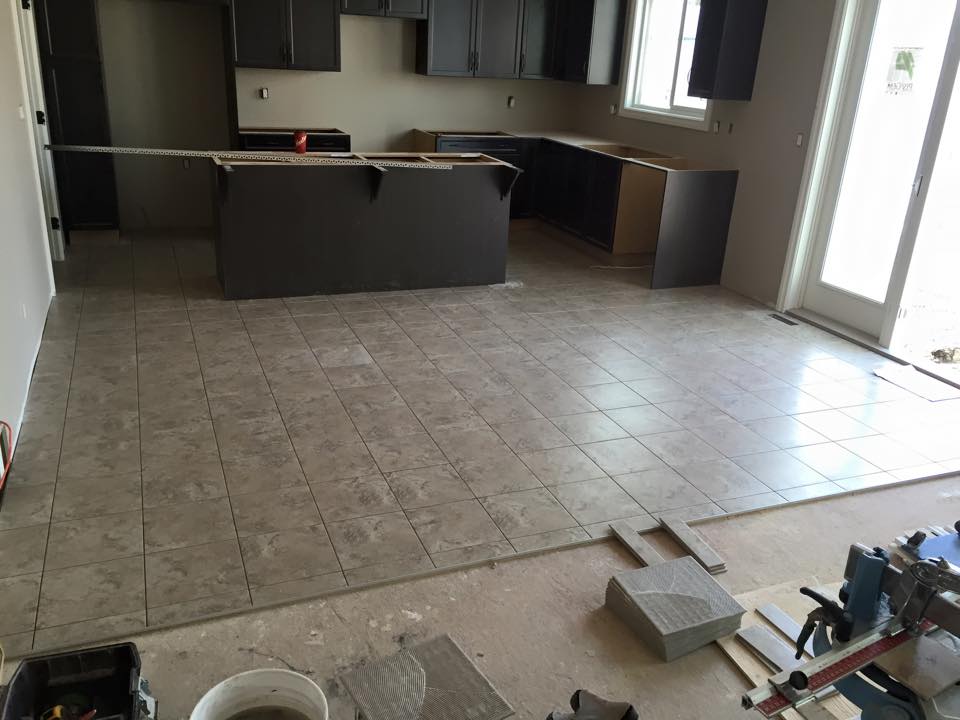
Why a 12×12 Straight Lay for an Open-Plan Main Floor
The format and pattern choice on this floor is 12 by 12 porcelain in a straight lay. What a 12×12 delivers at open-plan scale: a square format that holds proportion against a 600 to 900 square foot floor without the substrate-flatness demands of a 12 by 24 or the joint-count overhead of a 6 by 6 or a mosaic. The 12 by 12 is the format with the broadest tile selection at every price tier, which means the spec can deliver design quality on a new-build family-home budget. Why a straight lay rather than a stagger or diagonal: a straight lay (same geometry as stacked) produces an aligned grid where every joint runs continuously across the entire open-plan floor, reading as architectural and contemporary. A diagonal lay would have made the line-setting work harder still by introducing a 45 degree reference angle in addition to the wall-aligned lines, and a 50/50 brick lay would have introduced lippage risk at every joint corner across the open-plan footprint. A 70/30 stagger would have read as less decided than the straight lay. The straight lay is the move that holds across the full open-plan reading. Why a straight lay also helps the line-setting: on an open-plan floor where the layout has to balance multiple walls and transitions, a straight lay simplifies the geometry compared to a staggered or diagonal pattern, because the cuts at every wall are dictated by one set of perpendicular reference lines rather than by a more complex offset geometry. The straight lay reduces the line-setting complexity from a multi-axis problem to a two-axis problem, which makes the no-small-cuts principle easier to hold across the full open-plan footprint.
Why Prism Grout for an Open-Plan Main-Floor Joint
The full open-plan floor was grouted continuously with Prism. What Prism delivers on a main-floor open-plan install: a calcium-aluminate cement grout with stain resistance specifically calibrated for residential floor environments, including the cleaning cycles, foot traffic, kitchen spills, pantry exposure, and entrance grit that the open-plan floor sees across the warranty life of the install. Why a stain-resistant grout matters specifically on this floor: the floor runs from the entrance (where outside grit, mud, and salt come in on shoes) through the hallway, into the dining and kitchen zones (where food, drink, oil, and grease spills happen), and into the pantry (where dropped product and storage exposure happens). Each zone has its own potential stain source, and the joint has to handle every one of them. A standard portland-cement grout would absorb stain at the joint faster than the surrounding tile, producing visible joint discolouration over time that no cleaning regime can fully reverse. Prism’s calcium-aluminate cement is a denser, lower-porosity joint that resists absorption across every spill source in the open-plan floor. Why one grout colour continuously across all five zones: a single grout colour across the full open-plan footprint reinforces the material-continuous reading of the floor as one connected surface rather than as five separate rooms. Switching grout colour between zones would have broken the continuity that the straight-lay layout was set up to deliver.

Planning a large open-plan main-floor tile install where the line-setting has to deliver no small cuts at any wall in Beaumont or anywhere south of Edmonton? Call The Tile Experts at 587-333-9800 or request a quote.
Beaumont Open-Plan Floor FAQ
How much does a 600 to 900 square foot open-plan main-floor 12×12 tile install cost in Beaumont?
For a project of this scope (full open-plan main floor across kitchen, dining, entrance, pantry, and hallway, 12 by 12 porcelain in a straight lay, line-setting strategy delivering no cuts smaller than half a tile against any wall or transition, full Prism grout finish), plan on 8,500 to 14,500 dollars in tile-scope labour and material, with the total square footage and the perimeter complexity as the primary cost drivers.
Why is no small cut at any wall the principle to design the layout around?
A sliver cut against any wall reads as a compromise that the eye registers immediately. Holding to no less than half a piece of tile against every wall, doorway, cabinet face, and transition is what separates a designed install from a production install.
Why a straight lay rather than a diagonal or staggered pattern on a large open-plan floor?
A straight lay simplifies the line-setting geometry from a multi-axis problem to a two-axis problem, which makes the no-small-cuts principle easier to hold across the full open-plan footprint, while also delivering the most contemporary aligned-grid reading. See our floor tile installation service.
Tile Installation Across Beaumont and the South Capital Region
Beaumont sits south of Edmonton in Leduc County along the Highway 814 corridor, with neighbours in Nisku, Devon, Leduc, Calmar, and the southside Edmonton communities of Walker Lakes, Summerside, and Tamarack across the boundary. Large open-plan main-floor tile installs with line-setting work, 12 by 12 straight-lay specifications, and continuous Prism grout finishes are some of the most common projects in this 2010s and 2020s open-plan family-build market. The Tile Experts install floors, kitchens, bathrooms, custom showers, fireplaces, and feature walls across Beaumont, Nisku, Devon, Leduc, Calmar, and the rest of the south capital region, plus all of Edmonton. Contact us or call 587-333-9800 for a free in-home walkthrough.
More Projects in Beaumont and the Edmonton Area
Explore more recent tile installation work by The Tile Experts.