


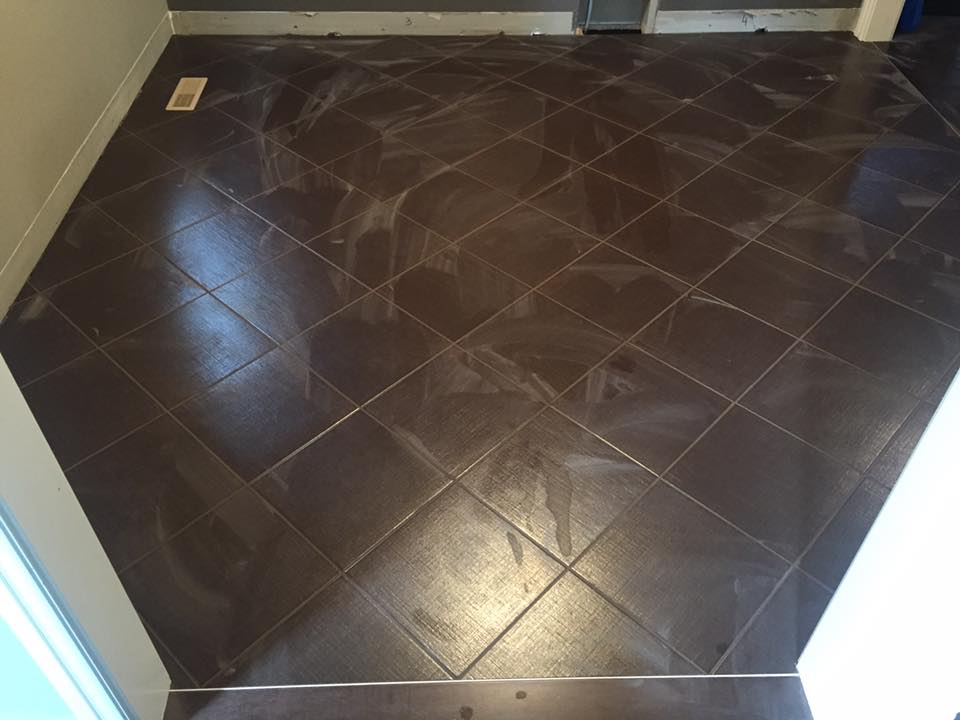
South Edmonton covers a broad band of established residential neighbourhoods running south of Whyte Avenue and north of Ellerslie Road, with a housing stock that ranges from 1950s post-war bungalows through 1990s split-levels and into the early-2000s infill builds. Floor tile renovations in this established stock often start with substrate prep work that a newer home would not require, because the existing subfloor has settled across decades and the original fasteners have backed off. On this south Edmonton renovation the prep stage was the headline scope: the entire plywood subfloor under the tile zone was re-screwed before any tile went down, then the homeowner-selected 12 by 12 porcelain was laid in a diamond pattern with VersaBond and finished with Prism Grout.
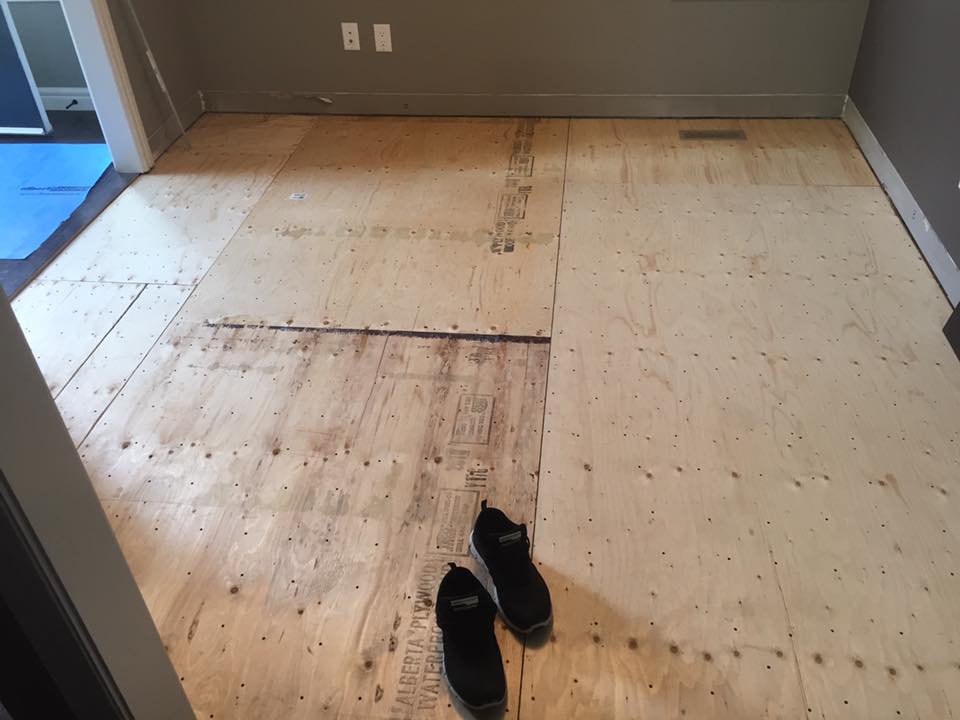
The first stage of this south Edmonton renovation was not laying tile; it was systematically driving screws down through the existing plywood subfloor into the joists below to eliminate any subfloor movement before the tile went on top. Why this matters: the original construction in an older home typically used nails to fasten the subfloor to the joists, and nails back out across decades of seasonal cycling. A subfloor that moves under foot traffic transmits that movement into the bond coat and then into the tile and grout joints. Over time, that movement reads as popped tiles (tile that has lost adhesion and lifts off the bond coat) and as cracked grout joints (grout that has fatigued under repeated micro-flex). The screw-down discipline: the prep crew systematically walks the subfloor with a screw gun, sinking screws every 6 to 8 inches along every joist line. The pattern catches every spot where the original nails have backed off and locks the subfloor tight to the joists so it cannot move under load. What this prevents: the most expensive failure mode in residential floor tile is a popped-tile field that requires removal and replacement of the affected tiles, often spreading well beyond the originally-popped zone because the adjacent tiles are also at risk. A 200-dollar subfloor screw-down prep stage at the front of the project prevents a 2000-dollar tile-replacement scope two years later. Why most contractors skip this step: the screw-down adds half a day to the project schedule and is invisible to the homeowner after the tile goes on top, which makes it easy to skip when a quote is competing on price. We do not skip it, because we get the warranty call when the floor pops.
The homeowner on this renovation specified a 12 by 12 porcelain laid in a diamond pattern rather than a conventional straight lay. What a diamond pattern means: the 12 by 12 tile is rotated 45 degrees relative to the walls of the room, so each tile reads as a diamond rather than a square, with the corners pointing toward the walls. Why a diamond pattern: a diamond layout gives a small or medium-sized room a sense of greater visual scale because the diagonal lines pull the eye across the room rather than letting the grid emphasize the room’s actual dimensions. The pattern reads as more design-forward than a straight lay, and on a renovation where the homeowner wants the new floor to read as a deliberate design upgrade (rather than a like-for-like replacement), the diamond is the move that signals the investment. The install discipline: a diamond lay is harder to install than a straight lay because every perimeter tile has to be cut on a diagonal, the layout has to start from a centred reference point rather than from a wall, and any irregularity in the room geometry shows up on the perimeter cuts. The setter has to dry-lay the field first to confirm the centred reference works in both axes, then commit to the bond coat. The bond coat: the field was set with VersaBond Mortar, the polymer-modified portland-cement thinset that matches the residential floor application. The bond strength carries the 12 by 12 across years of foot traffic, and the polymer modification provides the flexibility the substrate cycling demands.
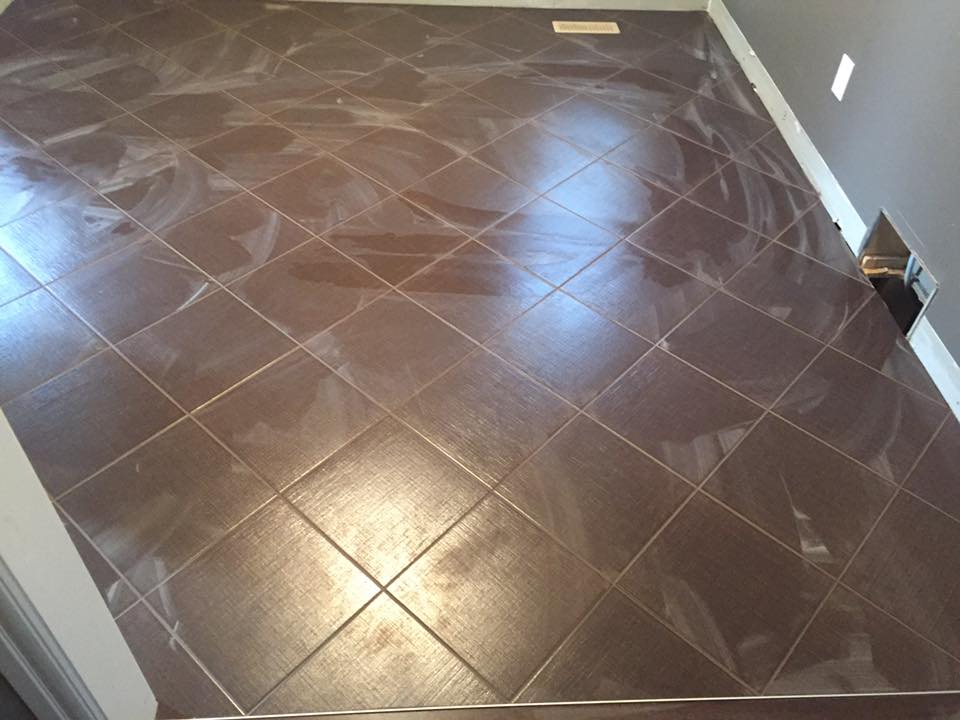
A diamond pattern install starts from a centred reference point in the room, which is fundamentally different from a straight lay that starts from a wall. Why centred: the diamond grid is rotated 45 degrees, so any irregularity in the room geometry (a wall that is not perfectly square to its opposite wall, a doorway that lands at an awkward measurement, a kitchen island that intrudes into the field) shows up on the perimeter cuts. Starting from a centred reference point distributes the irregularity evenly across all four walls, which makes the perimeter cuts read as proportional. Starting from a wall would push the entire irregularity onto the opposite wall, where it would show up as a series of awkward cut tiles. The dry-lay confirmation: the setter dry-lays the field across the room before committing to any bond coat, walking the layout and confirming that the centred reference produces clean perimeter cuts in every direction. If the dry-lay shows a sliver cut at any wall that would read as a layout defect, the centred reference is shifted by a half-tile or rotated slightly to land the cuts on better proportions. This is layout craft that takes time, and a setter quoting diamond-pattern work at straight-lay rates is going to either lose money on the job or skip the dry-lay and produce a floor with awkward perimeter cuts.
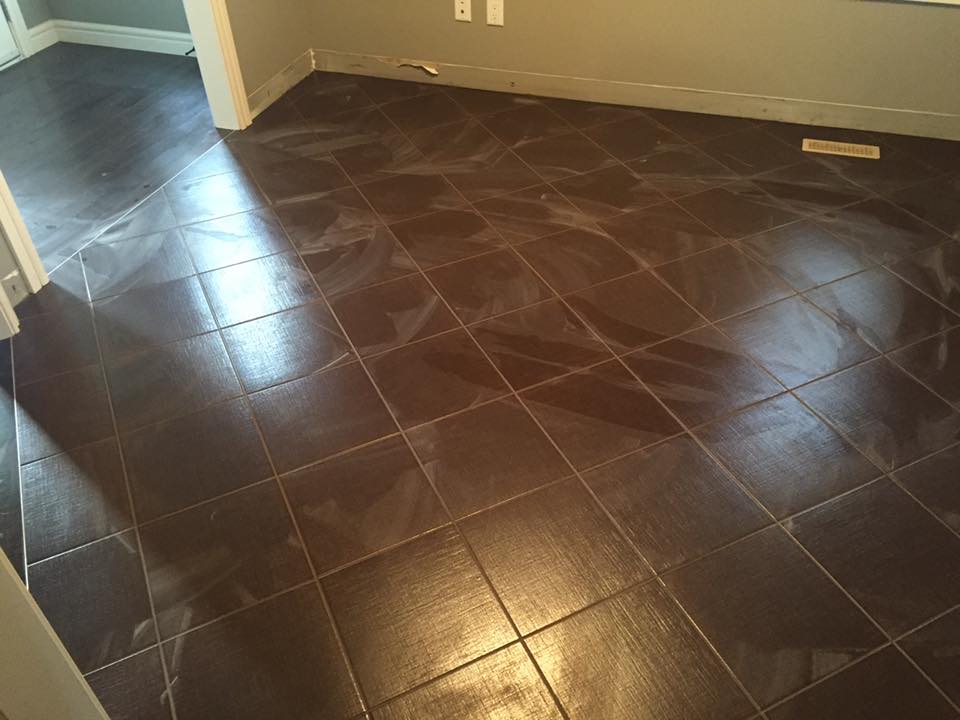
The diamond-pattern field was grouted with Prism Grout. Why Prism on a residential floor: Prism is a stain-resistant calcium-aluminate cement grout engineered specifically for floor applications where daily traffic, moisture from mopping, and cleaning-product exposure demand a grout that holds its colour reading across years. The calcium-aluminate chemistry resists efflorescence and bonds tighter into the joint than a standard cement grout. Why grout matters more on a diamond layout: the diamond pattern emphasizes the grid lines because the eye follows them diagonally across the room. Grout that loses colour or discolours unevenly reads as a defect on a diamond floor faster than it would on a straight lay, because the diagonal grout lines are the visual structure of the room. Prism’s colour stability across years of cleaning is the property that protects the diamond layout from looking tired before the tile itself shows wear.
Planning a floor tile renovation with subfloor prep and a diamond-pattern layout in south Edmonton? Call The Tile Experts at 587-333-9800 or request a quote.
How much does a 12×12 diamond-pattern floor renovation with full subfloor screw-down cost in south Edmonton?
For a project of this scope (full subfloor re-screw to eliminate movement, 12 by 12 porcelain in a diamond pattern with centred layout reference, VersaBond bond coat, full Prism grout finish), plan on 9 to 14 dollars per square foot in tile-scope labour and material, with the subfloor prep adding a fixed prep-day cost regardless of total floor square footage.
Why screw down the subfloor before tiling on a renovation?
The original nails fastening the subfloor to the joists back out across decades of seasonal cycling, and a subfloor that moves under foot traffic transmits movement into the bond coat and grout joints. Over time that movement reads as popped tiles and cracked grout. Re-screwing the subfloor locks it tight to the joists and prevents the most expensive residential floor failure mode.
Why does a diamond layout require a centred starting reference?
The diamond grid is rotated 45 degrees, so any irregularity in the room geometry shows up on the perimeter cuts. Starting from a centred reference distributes the irregularity evenly across all four walls, which makes the perimeter cuts read as proportional. Starting from a wall would push the irregularity onto the opposite wall as awkward cut tiles. See our floor tile installation service.
South Edmonton runs south of Whyte Avenue and covers a band of established residential neighbourhoods including Strathcona, Garneau, Ritchie, Hazeldean, Bonnie Doon, King Edward Park, and continues south through the older bungalow stock toward Ellerslie. Floor tile renovations with subfloor prep, diamond and offset layouts, and design-upgrade specifications are some of the most common projects in this established housing market that is now well into its second and third renovation cycles. The Tile Experts install bathrooms, kitchens, floors, custom showers, fireplaces, and feature walls across south Edmonton and the rest of the established residential core, plus the full capital region. Contact us or call 587-333-9800 for a free in-home walkthrough.
Trustindex verifies that the original source of the review is Google.
We had an amazing experience with The Tile Experts and couldn’t be happier with how everything turned out! They completed several projects in our home, including our kitchen backsplash, fireplace feature wall, and our front entry feature wall with soundproof panel boards. From start to finish, they were professional, knowledgeable, reliable, and detail oriented. The quality of their workmanship really shows, and they took the time to make sure every detail was done properly. Each of the projects involved different materials and finishes, and everything was installed beautifully. They were great to work with throughout the entire process, kept everything clean and organized, and we absolutely love how everything turned out! We would highly recommend The Tile Experts to anyone looking for quality workmanship, attention to detail, and a company that genuinely cares about the finished product! Special shout outs to Lydia on the backsplash Ewald on the rock and panel wall and Oscar/Judy for measuring/quoting!+2
Owner's reply
Thank you, Jackie, for your wonderful review! We're thrilled to hear that you had an amazing experience and are happy with the results of your projects. Your kind words about our team's professionalism and attention to detail mean a lot to us, and we appreciate your recommendation! Enjoy! it looks beautifulLidia did an excellent job on our tub surround she was professional,friendly and completely exceeded my expectations for the job. It was an absolute pleasure and if I ever have more tile work I would ask for her by name.+0
Owner's reply
Pat, Thank you for your wonderful review! We're thrilled to hear that Lydia exceeded your expectations and made your experience great. We look forward to new projects with you in the future, YAY tile work!Outstanding! From the initial contact and follow up by Judy, to Oscar's visit and diagnosis of the issue, to timely repair and installation of the shower floor by Ewald. Impeccable tile work and attention to details. Honest and hardworking team, 100 % recommended!+0
Owner's reply
Thank you, Josip, for the review! Our Tile experts Team thrilled to hear that Judy, Oscar, and Ewald provided you with exceptional service and quality work. Your recommendation means a lot to us! Thanks, Again.Lydia did our kitchen backsplash and we are so happy!! We will have her back to finish our bathroom in the new year.+0
Owner's reply
Thank you, Mackenzie! Makes happy that you love your kitchen backsplash. We look forward to working with you on your bathroom project in the new year!Great service .. 5 star ⭐️ easy to work with, quick response time and very accommodating! The backsplash looks great ! We are very pleased !+0
Owner's reply
Thank you Carolyn for your wonderful review! We're thrilled to hear that you enjoyed our service and are pleased with your backsplash. We appreciate your feedback and look forward to working with you again!Tyler from The Tile Experts did an amazing job. He cleaned the grout in our bathroom and it honestly looks like new again. He also helped seal some tile in our kitchen with silicone, which turned out great. Super professional, efficient, and easy to work with. Would definitely recommend.+2
Owner's reply
Thank you so much, Vitaly! We’re really happy to hear that Tyler did such a great job with the grout cleaning and tile sealing. Your recommendation truly means a lot to us!Very happy with our experience with the tile experts. Communications, quote and most importantly the work was great. Our kitchen backsplash looks amazing and we are very happy.+1
Owner's reply
Thank you so much for your review Mark we really appreciate your feedback and look forward to hearing from you in your future tile needs 😊I want to give a big thank you to The Tile Experts for such an amazing job on our bathroom renovation. I had reached out to a few local tile companies to get an initial estimate, and The Tile Experts were one of the only ones to promptly reply, and I am so glad that they did. There was one other company that said they would be available in 5 months to complete the job?! Ha! Our worker Glen was very kind and professional and did an amazing job! Communication and coordination with Judy was seamless and the job was booked quickly! This is everything that you would want from a contracting company. Will definitely be working with them again in the future!+0
Owner's reply
Thank you Nick for your wonderful feedback! We're grateful to hear that you had a positive experience with our team, and we'll be sure to pass your compliments to Glen and Judy. We look forward to working with you again on future projects!I am absolutely delighted about the results from the work performed by the Tile Experts team. They take pride in executing with excellence and accountability to ensure I was happy with the end product. The owners themselves came out to assess the job at the beginning and end to make sure it was done right. Special shout out to Lydia who not only demonstrated great communication skills and punctuality, she also is cool, calm and very, very competent in her job! I can’t wait to get the team back in to redo my bathroom in the next year! Added the before/after shots.+3
Owner's reply
Thank you so much for this incredible review Chris. Reading this honestly made my day. We take a lot of pride in doing things the right way, and it means a lot that you noticed the accountability and follow-through from start to finish. And thank you for the shoutout to Lydia! She’s talented, calm under pressure, and just an all-around great human to have on the team. I’ll make sure she sees your words. I’m really glad we could give you a result you’re proud of. Whenever you’re ready for the bathroom project next year, we’ll be just as excited as you are to help you create that next transformation. Thanks again for trusting us with your home.Lydia just did our kitchen backsplash and we are extremely happy with the job. I would guess the tile we chose is not easy to work with being tiny diamond shaped. Still, the backsplash looks excellent. Zero complaints and we will be contacting them for the next tile project. Only wish we knew about this company sooner. Highly recommend checking them out.+0
Owner's reply
Thank you for your wonderful feedback! We're thrilled to hear that you love your kitchen backsplash and appreciate your recommendation. We look forward to working with you on your next tile project!Excellent Service and Flawless Workmanship! I had a truly fantastic experience with The Tile Experts and highly recommend their services. I have a small condo they did a fantastic job installing the backsplash. From the very beginning, the process was seamless and professional. Oscar handled the initial measuring and consultation, and I was very impressed by how thorough and precise he was. He took the time to ensure every detail was accounted for, giving me full confidence in the quote and the planning. The installation itself went exceptionally well, thanks to the installer, Lydia. Lydia is an absolute gem and a very good worker. She was not only highly skilled—the finished tile looks truly amazing and the cuts are perfect—but she was also friendly and professional. Most impressively, she completed the entire project in a single day, which far exceeded my expectations. I am so pleased with the quality of the tile work and the overall service. I would absolutely recommend The Tile Experts to friends in the future, and they will be the first company I call for any future tiling needs.+0
Owner's reply
Thank you Lloyd for your wonderful feedback! We're thrilled to hear that you had a fantastic experience with Oscar and Lydia, and that you're pleased with the quality of our work. Your recommendation means a lot to us, and we look forward to assisting you with any future tiling needs!Tile Experts recently did my backsplash and modified my fireplace. They were very attentive and reliable from the quoting process through to project completion. The pricing was very reasonable, the craftsmen were very respectful of my home, keeping it very clean and liveable throughout the renovation. We were very pleased with the outcome and would highly recommend them.+1
Owner's reply
Thank you, Allan for your wonderful review! We're thrilled to hear that you were pleased with our team's attention to detail and professionalism throughout your project. Your recommendation means a lot to us!I was very happy to have been referred to Tile Experts. I had 2 gentlemen working on our project: Tyler did the grouting and Ewald did the install. Judy in the office kept in touch with me about progress and timing and that was much appreciated. Both guys worked well with my schedule and that was really helpful as I had to take time off work. The project turned out amazing! We are very happy with the result and would recommend these guys to do whatever project you have in mind. Clean, professional, courteous, timely and obviously very skilled.+1
Owner's reply
Thank you so much for this thoughtful review. We're really glad you were referred our way, and it means a lot to hear how smoothly everything went for you. Ewald and Tyler will be thrilled to know their work stood out. They both take a lot of pride in what they do, and they care deeply about giving people a result that feels amazing every time they walk into the space. We also appreciate you mentioning the communication from Judy at the office and how the team worked around your schedule. We know it’s not easy taking time off work, so hearing that we were able to make things easier for you genuinely matters to us. We’re happy you’re loving the finished project, and your recommendation means the world. Whenever you’re ready for the next idea or renovation, we’d be honoured to help you create that same sense of awe again.Tyler from Tile Experts did an amazing job regrouting our shower and floor tiles. Our grout was white, crumbling, and coming apart and it was sadly not that old. Tyler transformed it with a beautiful gray grout that not only looks modern and clean but will hold up much better over time. He was very knowledgeable and took the time to explain everything clearly before starting. I really appreciated how he made sure I understood the process and was comfortable with the plan before getting to work. He not only fixed the poor job that was done before, but also saved our shower from potential mold issues. The quality of his work was top-notch — quick, thorough, and professional. What really stood out was how he went above and beyond. He even did some patch-up work around the house — small things he absolutely didn’t have to do — just out of kindness. That level of care is rare and truly appreciated. Highly recommend Tyler and Tile Experts if you want honest, high-quality work done right the first time! Thank you Tyler for all of your help!+0
Owner's reply
Thank you so much for sharing this. I’m really glad Tyler was able to bring your shower and floors back to life. He puts a lot of pride into both the workmanship and the way he communicates, so it means a lot that you noticed the care he took in explaining the plan and making sure everything felt right before he got started. We also appreciate you highlighting the extra little things he helped with. That’s just who he is, and it’s great to see it recognized. Thanks again for the kind words and the recommendation. It truly means a lot to our team.Lydia did an amazing job on our bathroom! The clean lines and precise measurements, just amazing workmanship or shall I say workwomanship! I would highly recommend the Tile Experts!+1
Owner's reply
Thank you so much for this! I’m really glad to hear how much you loved the bathroom. Lydia will be smiling when she reads your comment about her “workwomanship.” 😊 She takes a lot of pride in those clean lines and precise details, so it means a lot that you noticed. We truly appreciate the recommendation and your kind words. Thanks again for trusting us with your homeGlenn from the Tile Experts did such a great job! Super professional and the tiles look amazing. I’m just the renter and my landlord covered the work, but I still wanted to leave a review because Glenn really deserves the praise. Even the plumber who came back before Glenn started, mentioned how excellent his work was.+3
Owner's reply
Thank you so much for taking the time to leave this review. Especially as the renter. That means a lot to us. I’m really glad Glenn made such a strong impression. He’s incredibly detail-focused, and he’ll be thrilled to hear both you and the plumber noticed the quality of his work. We appreciate you sharing your experience and giving him the recognition he deserves. Thanks again for the kind words.Highly recommend Tile Experts! Great price and service, with happy results. Amazing communication, provided the project schedule and finished quicker than estimated, and were clean while performing the work. Everyone who I dealt with was super friendly, and answered any questions.+1
Owner's reply
Thank you Derek for your recommendation and for your feedback on your kitchen backsplash tile installation project! We’re so glad to hear you were happy with the communication, scheduling, and overall experience with our team. It sounds like the clear timeline and clean, organized workspace really stood out, which is something we take a lot of pride in on every tile project. We truly appreciate your kind words and would be happy to help again anytime.Love how the Tile Experts have transformed our kitchen into a beautiful space. Amazing work. Thank you for your craftsmanship and professionalism.+0
Owner's reply
Thank you Chris for your kind words and for sharing the photo of your kitchen backsplash! We’re so glad to hear you’re happy with how the space turned out. It was a pleasure working with you on your kitchen backsplash tile installation, and we truly appreciate your feedback on our craftsmanship and professionalism. We’d be happy to help again anytime.Amazing job. They really are experts. Fair pricing and beautiful work.+0
Owner's reply
Thank you so much for your recommendation Geoff! We’re so glad you found us and we were able to facilitate. We look forward to working with you again in the futureThe entire team at Tile Experts made this part of my reno stress free from start to finish. Totally professional, listened to MY vision of the project and executed it to above my expectations. Glenn did a fabulous job and I hope he's going to be able to do my next project. Thanks to all for making my dream kitchen and bathroom a reality.+4
Owner's reply
Thank you so much for the kind words Dianne! We’re thrilled to hear that the process felt stress-free and that our team could bring your vision to life. Specially in two of the most important spaces in your home. You’re right about Glenn, he’s a gem, and we’ll make sure he sees your message. We’d love to be part of your next project when the time comes. Thanks again for trusting us to help create your dream kitchen and bathroom.Tile Experts did the tile in my new kitchen. It was a complicated design that needed meticulous detail and they totally nailed it. We did a hexagon backsplash with uneven design edges, that needed edging on each piece of tile. We also did large tiles on a bay window bottom, top and sides. It looks so good! The installer was a very kind man with a positive attitude and Ewald, one of the owners was also awesome to work with. Thanks Tile Experts for making my Pinterest kitchen come to life.+2
Owner's reply
Thanks so much Michele. It was a real pleasure bringing your Pinterest kitchen to life, and we’re thrilled with how it all came together. That kind of detailed work, from the hexagon backsplash to the bay window tiling, is where our team really shines. We’re glad both the craftsmanship and the experience made an impression.Our ensuite is travertine stone which requires special treatment to keep it looking good (cleaning the grout). From the quote to the finished job, everything was handled professionally.+0
Owner's reply
Thank you so much for the kind words Catherine! Travertine is a beautiful, timeless material—but we know how important it is to treat it with the right care, especially when it comes to the grout. From quote to final detail, we’re glad to hear the process felt professional and seamless. We always aim to make specialty stone work feel simple and stress-free for our clients. Looking forward to helping again if any future projects come up!The team at Tile Experts were so great to work with! We redid our ensuite and had considered doing the work myself, but the end result was SO much better than we could have imagined! We're finally back in our tranquil space and couldn't be happier :)+8
Owner's reply
Thank you so much, Doug! It really means a lot to hear that you’re loving the final result—and that we could help turn your ensuite into the tranquil space you envisioned. We know how tempting it can be to take on projects yourself, so it’s incredibly rewarding to hear that the outcome exceeded expectations. From start to finish, our team puts care into every detail to make sure the end result truly feels like home. Enjoy your peaceful space—and we’d love to help again whenever the next idea comes to life!Oscar, Judy and Ewald were great in all aspects. Were are very happy with how our backsplash turned out. Would recommend or use in the future.+0
Owner's reply
Thanks so much Gary! We’re thrilled to hear that you’re happy with your backsplash. It was a pleasure working with you, and we truly appreciate your recommendation. We look forward to working with you guys in the future.We recently had some renovation completed at our condo before we moved in. Ewald came to install a beautiful, 12 x 40 inch tile around the fireplace. Based on the texture/ pattern of the tile, it was a bit of a complicated install. Ewald did an AMAZING job. He was so precise with the measurements, ensuring the tile pattern was perfectly mat hed and even. He worked, clean and in an organized manner. He did an excellent clean up job when done. We are so happy with the tile work completed by Tile Experts and would very much recommend them.+3
Owner's reply
Thank you so much for your kind words and for trusting Tile Experts with your fireplace project! Ewald takes great pride in his craftsmanship, and it’s wonderful to hear that his precision and attention to detail made a difference in your space. We’re thrilled that you’re happy with the result and truly appreciate your recommendation. Enjoy your beautifully tiled fireplace in your new home!Beautiful tile install, good communication. Quality work!+0
Owner's reply
Thank you for your review, Joleen! We’re so glad you’re happy with the tile installation Lydia completed. Clear communication is one of our core values at The Tile Experts, and it’s wonderful to hear that it made a difference for you. Quality workmanship is always our priority, and we truly appreciate you taking the time to share your experience!Great experience with this company, they were very helpful, quick, on-time, clean and great value! My tub surround looks fantastic and I’m very pleased. Everyone was very nice, friendly and the communicated wonderfully every step of the way! Highly recommend. And because I was so pleased with their work, I asked them back to do my kitchen backsplash tile! I don't have photos of the finished tile yet, but trust me it looks very good. Ewald, Oscar, Glen and Judy are fantastic and I would say, this company is the best from start to finish.+0
Owner's reply
Thank you for your fantastic review! We’re thrilled to hear that you had such a positive experience with our team. It’s great to know that you’re pleased with your tub surround and that our communication, cleanliness, and timeliness met your expectations. Your recommendation means a lot to us. If you ever need anything in the future, please don’t hesitate to reach out. We’d love to work with you again!Leaving this review solely because of Glenn! Great person, and did an excellent job with our back splash. Felt very comfortable having him work in our home and he was very professional. Would recommend to others in a heart beat!+0
Owner's reply
Thank you for taking the time to leave us such a thoughtful review! Glenn truly is an incredible part of our team, and we’re so glad to hear he made you feel comfortable and provided excellent service with your backsplash installation. Your recommendation means the world to us, and we’re grateful for the opportunity to work in your home. If you ever need assistance with future tile projects, we’d be more than happy to help!We had a wonderful experience having our bathroom tile done by the Tile Installation Specialists. The floor and bath surround tile were replaced and both look beautiful now. We are very happy with the quality of the work that was done and Ewald was fantastic with communicating everything along the way. We will definitely be using this company again to have our kitchen tile done. Thank you for the beautiful, honest work!+3
Owner's reply
Thank you so much for your wonderful review! We’re thrilled to hear that you’re happy with your newly tiled bathroom floor and bath surround. It was a pleasure working with you to bring your vision to life, and we’re so glad you appreciated Ewald’s communication throughout the process. Your kind words about the quality of our work mean a lot to our team. We can’t wait to help transform your kitchen tile when you’re ready! Thank you again for trusting us with your home.I can’t say enough about their professionalism and workmanship. Ewald was wonderful to deal with and the project came out beautifully.+0
Owner's reply
Thank you so much for your kind words! We’re thrilled to hear that you’re happy with the professionalism and workmanship we brought to your project. Ewald truly takes pride in delivering exceptional results, and it means the world to us to know the outcome exceeded your expectations. If you know anyone else looking to elevate their space with expert tilework, we’d be honored to bring their vision to life too. Your recommendation means everything to us!Ewald was meticulous and professional through the whole process and did a great job.+1
Owner's reply
Thank you for your kind words! We’re thrilled to hear that Ewald’s meticulous attention to detail and professionalism stood out during your project. Delivering exceptional results is always our goal, and it’s great to know we hit the mark. We truly appreciate your support and hope to work with you again in the future!Beautiful job and I must say the quick communication is very much appreciated. Lydia is exceptional at her job in all ways. Such a wonderful and talented person. This is our second tile install from this company and I will continue to contact them as we finish our home upgrades.+0
Owner's reply
Thank you so much for your kind words and continued trust in us! We’re thrilled to hear that you’re happy with the tile installation and that our communication met your expectations. Lydia truly is an exceptional part of our team, and we’re glad her dedication stood out to you. It’s always exciting to see a home grow and transform, and we’re honored to be part of that journey with you. We look forward to working together again as you continue your home upgrades!Great company to deal with. They were quick in responding and providing a quote. Oscar confirmed that the measurements were correct. Ewald and team were very punctual, met our schedule and was a perfectionist working on the tile install of our fireplace and feature wall. I couldn't be more satisfied with the end product. I highly recommend the Tile Installation Specialists.+0
Owner's reply
Thank you so much for your wonderful feedback! We’re delighted to hear that you’re satisfied with the fireplace and feature wall installation. From the quick response to ensuring accurate measurements, we always aim to deliver a seamless experience. It’s especially rewarding to know that our attention to detail and punctuality made a positive impact. Your satisfaction helps us continue to grow and strive for perfection in every project. We truly appreciate your high recommendation and look forward to being part of your future tiling projects!Can’t say enough good things about this company. Ewald did an absolutely amazing job tiling our bathroom. He was very reliable, professional and never left a mess. I would 100 percent recommend hiring this company. We will be using this company for all our tiling projects in the future.+0
Owner's reply
Thank you so much for your incredible review! We’re truly honoured to have been a part of your bathroom tiling project. It’s feedback like yours that helps us continue to grow and improve as a company. Reliability, professionalism, and leaving a spotless workspace are core values we strive to uphold in every project. Your trust and recommendation mean the world to us, and we’re excited to grow alongside you as we take on your future tiling projects!Had a new basement bathroom installed last year by The Tile Installation Specialists. They came recommended by a friend and I picked them for the project because Oscar was engaged and asked lots of questions when he came to view the space for the quote. They were patient and accommodating when the vanity I ordered was delayed for months. And, when the vanity arrived damaged, they recommended a local granite company to replace the damaged top, which ended up saving me money. While we had design drawings for most of the layout, they executed the aesthetics part of it through a Pinterest board and my own hand drawings. Ewald was great with sending me videos to ask clarifying questions while I was at work. The tilework is superb and my husband comments this continuously. We are very happy with our bathroom and plan to use them from future renovations.+2
Owner's reply
Thank you so much, Candice, for sharing your experience! We’re delighted to hear that you’re happy with your new basement bathroom. Oscar and Ewald will be thrilled to know that their attention to detail and commitment to communication made a positive impact on your project. We’re glad we could help with the vanity situation and that our recommendation worked out well for you. It was a pleasure bringing your design vision to life, and we’re especially pleased that your husband continues to enjoy the tilework. We’re looking forward to working with you on future renovations!Ewald was amazing! He was onboard with my crazy yellow tile and made it look great. He was punctual and clean. I very much appreciated his expertise. And everyone at Tile Installation Specialists.+1
Owner's reply
Thank you so much, Andrea! We’re thrilled to hear that you’re happy with how the yellow tile turned out. Ewald had a great time working on your project, and we’re glad his expertise and attention to detail made a difference. It was a pleasure collaborating with you, and we’re so glad you enjoyed working with the entire team at Tile Installation Specialists. If you ever have more design ideas in the future, we’d love to bring them to life for you!Ewald was amazing! On time , professional, had the cleanest worksite I have ever seen . When we had questions or asked his opinion he was always very helpful . Although our job was small it was done with perfection . Won’t hesitate to use them again when the main floor gets done next year !+0
Owner's reply
Thank you so much for your kind words! We’re thrilled to hear that you’re happy with the results. At our company, we always strive to maintain a clean and professional workspace, so it’s great to know that it made a positive impact on your experience. We’ll be sure to pass along your compliments to Ewald—he’ll be delighted to hear them! It was a pleasure working on your project, and we look forward to helping you with the main floor next year. If you have any more questions or need anything else in the meantime, please don’t hesitate to reach out!Shower floor tile repair - they did an incredible job. I was so grateful they managed to come in and complete the repair before I had surgery (and needed to use the safer shower instead of our other bathroom tub). The job required scraping the old grout out, regrouting the existing tile and adding/replacing silicone in the corners. It cost $1,400 (which isn’t cheap but it would have taken my husband at least 10-14hours and he didn’t have that kind of time). I actually had a really hard time finding anyone that repairs tile. Most companies seem to only want to do the work if it is a complete remodel/from scratch... Excellent customer service from start to finish. Communication was outstanding. I absolutely love their admin person, Judy. They seem like nice honest people. Highly highly recommend and would use them again.+1
Owner's reply
Thank you for your positive review, Michelle! We are glad to hear that our team provided excellent customer service and completed the repair before your surgery. We appreciate your recommendation and hope to work with you again in the future.The Tile Installation Specialists transformed our home with expert craftsmanship, professionalism, and an overall great experience. I highly recommend them for flawless tile work, done right!+2
Owner's reply
Thank you Kari for your kind words! We are thrilled to hear that our team was able to provide you with exceptional tile work and a positive experience. Thank you for recommending us!Oscar and his team helped me to make some great choices and gave me good information before I even decided to hire them. The project was completed as expected and on schedule, and all communication was prompt and clear. We would hire them again for our next bathroom.+0
Owner's reply
Thanks Jeff for your review. We appreciate you taking the time to share your experience. Every word you've shared plays a pivotal role in nurturing our journey towards becoming the industry powerhouse we aspire to be. We're beyond grateful for this and for the trust you've placed in us. Knowing you'd choose us again for your next project fills us with excitement and determination. Thank you from the bottom of our hearts for being a part of our growth. Here’s to the future and all the amazing projects we’ll tackle together!Finding good and reliable trades for our business is hard but since using The Tile Install Specialists we never have to worry about the quality of work for tiling because it always turns out amazing!+2
Owner's reply
Thank you for your kind words! We're thrilled to hear that The Tile Installations Specialists has become your go-to for reliable and high-quality tiling work. Ensuring your complete satisfaction with every project is our priority, and it's great to know we've hit the mark for you. We appreciate your trust in us and look forward to continuing to support your business's needsEwald and Oscar are very easy to deal with. Very good communication and everything was on schedule. All the other staff were personable and professional. Great experience+2
Owner's reply
Thank you for your kind words, Susan! We are glad to hear that your experience with Ewald, Oscar, and our staff was positive and that everything went smoothly. We hope to have the opportunity to serve you again in the future.Finding a tile setter who completes the work well is a challenge. I’ve have worked with many great installers. Oscar and team are right up there with the greats. I’ve had the pleasure of working with Oscar and his team starting in 2023 and the projects have been done to the highest standard. The front office was quick to supply quotes and ask the typical detail questions such as tile selection, water proofing, and schedule. There installing team were polite with customers and work at a quality installation pace. The also appreciated and respected the living spaces and construction areas. When requested to work over some temporary surface protection they obliged and apologized even to not needed. There projects turned out fantastic. Oscar and team are super friendly and great to work with. I foresee many more projects together in the future.+0
Owner's reply
Thank you for your positive review, Kyle! We are glad to hear that you have had a great experience working with Oscar and our team. We strive to provide high quality work and excellent customer service. We look forward to working with you on future projects.We redid both of the bathrooms in our 1957 home, which Oscar and Ewald did an excellent job of. The floors, tub surrounds, and base boards were tiled, which being an older home, nothing was straight. The team at Tile Installation Specialist did an incredible job of hiding our out-of-level bathroom. If you have an older home - choose experts, as their experience shows. Their pricing is very honest - especially when it came to bringing in sub-trades for framing and drywalling. We will be using the Tile Installation Specialist again! P.S I would HIGHLY recommend purchasing your tile from Julian Tile. You will pay more than Lowe’s or Home Depot, but the tile is top quality.+1
Owner's reply
Thank you for your kind words Logan! We are so pleased to hear that you are satisfied with our work and that you found our pricing to be honest. We look forward to working with you again in the future. We couldn’t agree more, Julian Tile has top quality tile products!Oscar and Ewald were amazing right from the beginning of our basement bathroom through to the end. Even when the heated sensors quit for the floor they were there to find the problem and fix it. I will definitely use them again in the future if we have another project to do!+2
Owner's reply
Thank you Cathy! Yeah those sensors gave us a hard time but we got them taken care of. Thank you for the work and well look forward to working with you againWe had found that the wall behind our shower had rotted out. After shopping around we found The Tile Installation Specialists and they were great to work with. Willing to work within our budget, helping us choose the best options for us. The work done was amazing. Couldn't be happier.+0
Owner's reply
Thank you Michael. It was a pleasure to work with you guys.They put ledgestone on our gas fireplace and did an amazing job. Safely removed dated tile and gold trim and installed the ledgestone meticulously, leaving no mess. Communication was great from first contact, to quote, to choosing our preferred facing. I would highly recommend.+1
Owner's reply
Thank you Lowell for the opportunity and we're happy with the job completed.Both Oscar and Ewald were fantastic to work with in bringing my wall tile installation to completion. They were professional, courteous, knowledgeable and understood the need for attention to detail in order to make the project a perfect one. The final result is amazing!+0
Owner's reply
Thank Karen it was a pleasureWe contacted the Tile Installations Specialists to tile the shower/bathroom in our Sprinter Van. They were up to the challenge and excited as they had not completed work in a van before. They were punctual, responsive, professional and all around awesome to work with! The tile looks amazing and has received numerous compliments. We have nothing but positive things to say about this company. They made the experience a great one! Thanks so much Oscar and Ewald!+1
Owner's reply
Thanks Amanda! We’re happy to have done the work for youEwald did an amazing job on our kitchen backsplash. All lines are crisp and clean and everything was cleaned up at the end of the day. Tyler also did a great grouting job and then even did some finishing touches on our fireplace tile from a year ago!+0
Owner's reply
Hey Lindsay. Thank you, It was great to do another job for you guys! and look forward to doing the one coming up right away =DEwald was our installer and he was amazing at what he did. He asked questions to ensure what we wanted was being done. Although the job looked small it was very challenging as Ewald had to make small cuts around the hardware of our fireplace. The quality of work is impeccable and they will definitely be doing the next tiles job we have. Thanks to Oscar and Ewald!+1
Owner's reply
Thank you so much Corbin! We defiantly take pride on attention to detail =DThe wife and I are quite impressed with how it turned out looks awesome. Everything went very smoothly from getting an estimate to getting backsplash installed. Ewald & Oscar are very friendly. Ewald showed great craftsmanship & professionalism. I would definitely use the Tile installations specialists again.+4
Owner's reply
Hey Bryce! Thank you for choosing us to do the work! We’re very grateful!We are thrilled with how our full bathroom renovation turned out! The Tile Installations Specialists exceeded our expectations throughout the entire project. Both Oscar and Ewald are an absolute pleasure to deal with. The tile work is absolutely sublime and the project was handled superbly by from start to finish. You can tell this company really values and respects its customers. We highly recommend and look forward to our next project with this company!+1
Owner's reply
Hey Ammanda!! Thank you so much! We had an amazing time working with you guys. You did an awesome job with product selection and we too are just so happy with the turn out. It’s a beautiful bathroom. A master piece!Quote was quick and accurate. The work was done in a timely manner and the finished product looks great. They made great suggestions while installing the tile to give us a better finished product.+0
Owner's reply
Hi Tamara! Thank you, thank you, thank you!We were originally very nervous about renovating our shower in our master bathroom, it’s not something you do everyday. So glad we chose Tile IS. Ewald and Oscar were absolutely outstanding and I highly recommend them. We absolutely LOVE our new shower.+0
Owner's reply
Thank you Brett! It was a great time working with you. We’re are grateful you chose us!Ewald and Oscar were so professional and kept their work area so clean. They are perfectionists and it shows in their work. Our quote was quick and lower than anywhere else we got. Highly recommend!+0
Owner's reply
Thank you Caitlin! It was nice seeing you guys again! Happy to help with your tiling needsWe are very happy with the customer service (Oscar is very friendly and quick response time) and workmanship from the Tile Installation Specialists. Ewald removed our old kitchen tile and installed new tile. He is professional, efficient, and his work is incredible! We couldn't be more pleased. I shopped around and found their pricing was reasonable. I will definitely be calling them when we renovate our bathrooms; I don't need to look any further or do additional price checking. They are trustworthy and the service is amazing! I'd highly recommend this company. You won't be disappointed.+0
Owner's reply
Hi Christina! thank you so much for giving us the opportunity. We look forward to working with you guys again.They were able to squeeze in my bathroom tile job and I really appreciated it. Always a pleasure to work with them. I know that I can trust them. In this particular instance I only had one key and I felt very comfortable leaving it with them. Communication throughout was excellent and their tile work is spot on. They left the site clean and with no garbage. I look forward to work with them again in the future.+1
Owner's reply
Thanks Edward. We look forward to working with you again.TIS completed our floor renos yesterday- from lino to tile in kitchen, hallway, foyer, bathroom, and laminate in the office room. We were very pleased with their quality of work. They are honest, friendly and reliable. Ewald did most of the work and he is skilled and attentive to detail. Both Ewald and Oscar gave us valuable suggestions and kept us informed. Prices are reasonable. They also have an experienced and dependable crew working for them. Thank you TIS and crew for a job well done. We would highly recommend this team.+1
Owner's reply
Thanks Steve! We’re glad you’re happy with the final product. It was a pleasure working for you.Awesome work! Fast, efficient and clean.+0
Owner's reply
Thank you Paul! We're glad happy your happy with the outcome and we look forward to that next project.I'm certain that The Tile Installation Specialists are the best tile installation company in Edmonton. The guys are smart, professional, and absolute experts at their trade. They elevate the trade to a craft. They did a beautiful job tiling our entire kitchen with subway tile when we had it redone, and there were a ton of tricky corner, and edge pieces to sort out. The finished tiling job was perfect. They also repaired some tiles in our shower, and redid our front steps with a beautiful quarry tile that fits perfectly with our heritage home. I hope they stay in the trade for the long haul, because we feel fortunate to have found such an expert and reliable company that does excellent work. We will call on them for any future tiling projects.+0
Owner's reply
Thank you so much Darren. We've enjoyed all the projects we've done for you guys. Beautiful family you guys have.We are extremely happy with our experience with The Tile Experts. From the estimate to the install, it has been a thoroughly positive and professional process. Our tile setter, Lydia was just awesome showing great expertise, precision, and craftsmanship. We would not hesitate to recommend this company.
Owner's reply
Thank you, Dawn, for your wonderful feedback! We're thrilled to hear that you had a positive experience with our team, especially with Lydia's expertise. we really appreciate you and your future recommendations.So happy with our kitchen backsplash! Lydia did such an amazing job. She was here early and finished before I was even home from work. The whole process was a great experience. We had someone come out to quote us and look at the job, from there we were promptly booked a date for the work to be done. This was the most stress free experience we’ve had with all our renovations by far! Thank you !
Owner's reply
wow Jodi, Thank you, for the kind words! We're thrilled to hear that you’re happy with your kitchen backsplash and that Lydia provided such a seamless experience. Your satisfaction means a lot to us.Tile Experts did an amazing job on our floors. They turned out even better than we expected! They were so accommodating with our specific requests and really went above and beyond. My husband is a very particular carpenter who notices every detail, so we wanted to make sure we hired a professional company, and they definitely delivered. We couldn’t be happier with our beautiful floors. Thank you!
Owner's reply
Thank you, Leanne, for your wonderful feedback! Music to our ears to hear that you and your husband are so pleased with the floors and our team's attention to detail. Your satisfaction means everything to us! cheers!Fantastic!! Tyler from The Tile Experts did a fantastic job cleaning up our tiled areas in our 10 year old house. He cleaned, regrouted were necessary, resealed, and recalked virtually all of our tiled surfaces in our 10 year old Ace Lange house. I honestly think his work was the best possible. Tyler was very professional, clean, polite, and punctual. Super guy! Tyler even stopped by to look at the project before we decided to go ahead with the work to evaluate the situation and let us know how it would all go and to ensure the pricing was accurate. I would highly recommend Tyler and The Tile Experts to anyone looking to having similar work done. That said, based on Tyler and the work he did in our home, I would not hesitate to hire the Tile Experts to do any type of tile work for us.
Owner's reply
Thank you so much, Kirk, for your fantastic feedback and kind words! We're really happy to hear that Tyler impressed you with his professionalism and the quality of his work. Your recommendation truly means a lot to us, and we can’t wait to help you with any future tile projects!🥳We had a great experience with Tile Experts. Judy was extremely helpful and quick to get back to us, booking was straightforward without long waits, and Glenn installed our tile with precision! We are so happy with our new tiled bathroom floor.
Owner's reply
hello, Sarah! We're thrilled to hear that Judy and Glenn provided you with exceptional service and that you're happy with your new bathroom floor. Thank you for the awesome review. ENJOY!The Tile Experts really do live up to their name! They took a difficult geometric layout with handmade Moroccan tiles and made it into a stellar bespoke hearthpad for a wood stove. Extremely satisfied and would totally have them do similar work again.
Owner's reply
Thank you, Nathan! We loved the challenge and for your wonderful feedback! We're thrilled to hear you’re satisfied with t our team's expertise. We look forward to working with you again in the future! whoohoo!We had a great experience with Tile Experts from start to finish. Ewald did a fantastic job and took the time to work through our tile pattern using the tile we had chosen. The installation was very well done, and we’re extremely happy with the results. We will definitely be hiring Tile Experts again for our next project!
Owner's reply
Whoo hoo thank you, Kellea, for your wonderful feedback! We're thrilled to hear that Ewald's expertise and attention to detail made your experience exceptional. We look forward to working with you again on your next project! thank you for the kind words.From start to finish, this company exceeded expectations. Thank you Lydia and Ewald, for the efficient and beautiful transformation. Thank you to all others that assisted with timely communication and scheduling.
Owner's reply
Hello Jenna! We’re thrilled to hear that Lydia, Ewald, and the team were able to exceed your expectations. Your satisfaction is our top priority, and we appreciate you taking the time to give us a great review!We're in the middle of rebuilding our bathroom with a curbless shower and heated floor using Schluter Kerdi and Ditra products. The Tile Experts (Ewald) were able to seamlessly come in and handle the task of fixing up the waterproofing and tiling the flooring with the appropriate slopes to the drain. It looks fantastic. We're looking forward to having them back again when the rest of our tile comes in.
Owner's reply
Thank you, Jack, for your wonderful feedback! We're thrilled to hear that you're pleased with the waterproofing and tiling work. We look forward to assisting you again when your tile arrives!Easy to get an estimate and schedule an appointment. Shower floor looks incredible!!
Owner's reply
We're glad you found the process easy and love your new shower floor! Thank you MarcelaOur shower looks like new! I would recommend Tile Experts for their excellent communication and great quality of work .Thank you, Judy and Tyler!
Owner's reply
Whoohoo! Thank you so much, Katie! We're really excited to hear that you're enjoying your shower and that our team's communication and quality of work met your expectationsAmazing work and fair price! Showed up when they said and was extremely easy to deal with. Highly recommend!
Owner's reply
Thank you, Matt! We're glad you had a great experience.We recently had The Tile Experts complete a project that included deep cleaning and sealing the grout on our shower surround and floors throughout our home, along with resetting, re-grouting, and sealing the tiled floors in a couple of our bathrooms. This project came with a whole host of unforeseen challenges, but our installer, Tyler, was truly exceptional throughout the entire process. He uncovered multiple issues from a poor tile installation done decades ago, yet he rose to every challenge with skill, patience, and a great attitude. Tyler was incredibly communicative and honest, taking the time to explain the underlying problems he encountered and what needed to be done to properly address them. His problem-solving abilities were impressive, and his workmanship was outstanding. He is extremely talented and clearly a true expert in his field -- hardworking, professional, respectful, and genuinely a pleasure to deal with. We also really appreciated Judy on the administrative side. She was prompt and organized in sending updated change orders as the project evolved, which made everything smooth and easy. Overall, we had a simply wonderful experience with The Tile Experts. The quality of the work and the professionalism shown by both Tyler and Judy truly stood out. The Tile Experts absolutely lived up to their name, and we’re so happy and grateful for the excellent service and results! The countless 5-star Google reviews are clearly well earned!
Owner's reply
Thank you, Crystal, for your detailed and positive feedback! We're thrilled to hear that Tyler and Judy provided exceptional service and that you are pleased with the results of your project. Your satisfaction is our top priority, and we appreciate your kind words and trust in us The Tile Experts.We had a great experience with Tile Experts. We have tiles in our bathroom and main floor that are 40+ years old. We worked with Tyler and had an honest conversation about options to remove existing tiles or leave them in place, install new tiles, and options for extending their life. The best thing we did was ask if Tyler (the installer) could come to our house and look at the tiles in person - we initially tried to assess the tiles and come up with a scope and estimate over the phone and with pictures, but with the uniqueness of this job, having Tyler look at them in person helped us finalize our approach (and to make sure we were all in alignment with expectations of the final product - again, these were 40+ year old tiles, so we knew there was only so much that could be done). In the end, we ended up doing as much maintenance as possible to extend the life of the tiles and grout - and we even replaced a couple of tiles. Tyler has such a great attitude and took so much care and pride in his work; we couldn't be happier. True, the tiles will not last forever, but we were so happy with the work that was done and the care taken to extend their life. I would recommend Tyler (and the Tile Experts) to anyone.
Owner's reply
Thank you, Devin, for your wonderful review! We're thrilled to hear that Tyler was able to provide valuable insights and that you're pleased with the maintenance and care taken with your tiles. we look forward to assisting you again in the near future!I’m very pleased with the efficient and high-quality work done by Tyler. The regrouting of our shower tiles makes the 27 year old surround look like new! I also found the booking, billing, and payment options very easy to navigate. I will definitely recommending The Tile Experts to my friends.
Owner's reply
Thanks so much for the kind words! We're glad Tyler could help bring your shower back to life. We really appreciate the recommendation and hope to work with you again down the road!The Tile Experts are a fantastic group; From Judy, the ever responsive admin, to Oscar, the efficient inspector, and Glen, the gentle expert tiler, I was beyond impressed. I had a great experience with this Company and I, unreservedly, recommend them. You won't regret it if you entrust your tiling job to them.
Owner's reply
Thank you, Temitope! Amazing to hear that Judy, Oscar, and Glen made such a positive impact on your experience. Your recommendation means a lot to us. Thank you againHired them to do a regrout of my old shower surround and they did a fantastic job. Tyler was very knowledgeable and honest. He did a great job with the tile work, and kept the work area nice and clean. I would 100% hire them again for future jobs.
Owner's reply
hello and Thank you, Erin for the feedback! Providing excellent service and that you're pleased with the results brings music to our ears. We look forward to working with you again in the future!Great quality work and attention to detail, turned our floors into artwork. Much appreciated.
Owner's reply
Thank you so much, Jon and Jenn! We're really happy to hear that you love your floors. Your kind words about our attention to detail mean a lot to us. It was a joy working with you!Easy to work with, communication on point, efficient, detailed and an eye for perfection. Would recommend, especially to women clientele. Lydia is a safe professional to have in your home.
Owner's reply
Thank you so much, Kimberly, for your lovely words and recommendation! We’re really happy to hear that you had a great experience with Lydia. Your trust in our services truly means a lot to us!Tyler did an excellent job on my bathroom. Highly recommended. Would definitely hire again!
Owner's reply
Thank you, Monika! We're thrilled to hear that you’re pleased with Tyler's work on your bathroom. We look forward to the opportunity to assist you again in the future!Tyler showed up on time and did an amazing job of my bathroom. Looking after cleaning and restoring my tiles to the original look. Really happy with his work and will use Tile experts again if needed. Thank you
Owner's reply
Thank you, Kathy, for your wonderful feedback! We're thrilled to hear that Tyler exceeded your expectations and restored your bathroom tiles beautifully.Tyler came to our house and restored our kitchen tile to better than brand new. He was very knowledgeable about products and gave good advice on how to keep our tile looking good. He was extremely polite and hardworking.
Owner's reply
Thank you so much for your kind review. Tyler is a trusted and valuable member of our company and we’re thrilled to hear how happy you guys are.Tile experts tiled my shower surround and bathroom floor. The overall price was much better than other quotes I received and they did a fantastic job. Judy was great to deal with. She booked me in very quickly and also responded to any of my enquiries just as fast. My tiler Glen did an incredible job. He was very meticulous and thorough. He was also very respectful of my home, leaving the job site at the end of the day in pristine condition. The owners of the company also scheduled a follow up with me upon completion to address any questions I may have had. Highly recommend Tile Experts.
Owner's reply
Thank you Nadia, for your wonderful review! We're so happy to hear that you were satisfied with our pricing and the quality of Glen's work. We appreciate your recommendation and look forward to serving you again in the future!From start to finish tile experts were excellent. We are so happy with the final product. We will be hiring them again in a couple of months. Thanks tile experts !!
Owner's reply
Thank you so much Nat for your wonderful feedback! It means a lot to the entire team to hear that you're happy with the final product and look forward to working with you again in a couple of months. Your satisfaction is our priority!We had a great experience with Judy, Ewald and team. They did excellent work and helped us through a minor issue to ensure our satisfaction. We will come back and recommend to others!
Owner's reply
Thanks Rachal, your kind words means a lot! We're thrilled to hear that Judy, Ewald, and the team provided you with excellent service and support. We look forward to welcoming you back and appreciate your recommendations!The guys that came where very personal and they did a great job. I would recommend them and would hire them again. They did a great job
Owner's reply
Thank you Mike for your feedback on your tile installation project! We’re so glad to hear you had a great experience with our team. It means a lot that you trusted us with your tile work, and we’d be happy to help again anytime.We had Tile Experts do a floor repair on our walk in shower . They were very professional and did a fantastic job . Their cleanliness and expertise was exceptional.
Owner's reply
Thank you Marlene for your positive feedback! We're excited to hear that you were satisfied with our team's professionalism and the quality of their work.I am thrilled with the job Tyler did in replacing my cracked and worn grouting in my slate floors. He was on time, did a fantastic job and was very courteous and helpful! I wouldn't hesitate to recommend the Tile Experts to anyone needing tile work done.
Owner's reply
Thank you for your wonderful feedback Joanne! We're delighted to hear that Tyler provided excellent service and that you're pleased with the results. Your recommendation means a lot to us!I’ve had the opportunity to work with The Tile Experts on many projects, and they consistently do outstanding work. Their team is professional, reliable, and the quality of their craftsmanship really stands out in the finished product. As someone who works in construction and demolition, I really value trades that communicate well, show up when they say they will, and take pride in their work. The Tile Experts check all those boxes. Their attention to detail and professionalism make projects run smoother for everyone involved. I would highly recommend The Tile Experts to anyone looking for high-quality tile work.
Owner's reply
Thank you Adam for your generous feedback and recommendation. We take pride in our team's professionalism and craftsmanship, and we're glad to hear that our work has contributed to the success of your projects. We look forward to collaborating with you again in the future!Tile Experts provided a quotation promptly and sent Tyler Bryson to remove and replace the 3 walls of grout in our master shower. Tyler carefully and professionally dug out the existing grout with minimal dust and debris and then installed a much better quality of grout with excellent workmanship! He noticed we also needed some extra work to upgrade the floor and recommended we do that while he was there. Judy promptly provided us with a very fair extra cost and we approved it and Tyler completed the work within the original schedule. Tyler is a testament to his trade - highly recommend Tile Experts and him !
Owner's reply
Thank you DeWayne for your fantastic review! We're thrilled to hear about your positive experience with Tyler and appreciate your recommendation. Your satisfaction is our priority, and we look forward to serving you again in the future!Working with The Tile Experts was seamless from the beginning. Every part of the process was communicated clearly and efficiently thanks to Judy. Ewald is a true craftsman. He clearly takes pride in his work. My fireplace is a piece of art. Some of the words used to describe it from friends and family are, gorgeous, stunning, beautiful, and amazing! I know I will enjoy it's beauty and quality for many years to come. If you want to hire a company that has integrity and truly cares about providing top notch workmanship, do not hesitate to hire The Tile Experts. I know I will hire them for any future tiling projects.
Owner's reply
Thank you so much Marcy for your thoughtful review. We’re so glad to hear that your experience felt seamless from start to finish and that the communication and process stood out along the way. It’s especially great to hear how much you’re enjoying your fireplace feature wall. Hearing words like “gorgeous,” “stunning,” and “beautiful” is exactly what we aim for when delivering a custom tile installation like this. We’ll be sure to pass your kind words along to Judy and Ewald. We truly appreciate your trust in us for your fireplace tile project, and we’d be happy to help with any future tile installations whenever you’re readyLooking forward to a phone call.So I could be wowed.
Owner's reply
Hello Erich please give us a call or text at 15873339800I am moving out of a rental apartment. Some of the grout in the bathroom tiles had broken off and fallen away. The Tile Experts sent over Tyler and he fixed it up. He even told me how to clean the rest of the grout to get it back the original colour before the move out inspection. Looks great! Quick estimate and affordable, too.
Owner's reply
Thank you for your wonderful feedback Ella! We're glad to hear that Tyler was able to assist you and that you're pleased with the results. Best of luck with your move!They did a great job with my washroom tile floor . Tyler was knowledgeable, honest, and answered any question that I had. I would recommend this place for any major work down the road.
Owner's reply
Thank you Shaheer for your kind words! We're glad to hear that Tyler provided you with excellent service and that you're satisfied with your washroom tile floor. We appreciate your recommendation and look forward to assisting you with any future projects.Judy, Lydia, Oscar and Ewald are amazing. We love the tile backsplash they installed for us. There is no other tile company we would recommend higher than the Tile Experts. 🙏
Owner's reply
Thank you Trevor for your kind words! We're thrilled to hear that you love the tile backsplash and appreciate the hard work of Judy, Lydia, Oscar, and Ewald. Your recommendation means a lot to us!Our poor old bathroom was in need of a refresh. We contacted Tile Experts and heard back from them very quickly. Oscar was out within the week to do a full evaluation and some recommendations. A very comprehensive quote was sent to be reviewed. Ewald and team began work on the date promised and continued until completion with first the demolition, wall boarding, then tile setters, plumbers etc. Each team of experts were on time, very professional and took extreme care with our floors coming in and out. The site was always left 'clean' and 'tidy' inasmuch as a worksite can be:). We were impressed the the skill of the tradespeople and their always polite presence. Judy on the backend of sending the updated paper work and invoices is efficient and sweet. Overall I would recommend them. They really take care to do a quality job - no rushing and making mistakes. Doing it right the first time.
Owner's reply
Thank you, Marilyn for your wonderful review! We're thrilled to hear that you had such a positive experience with our team and that you appreciated the professionalism and care taken throughout your bathroom refresh. Your recommendation means a lot to us, and we look forward to serving you again in the future!Thank you to Tyler for his professional, pleasant and prompt repair of the caulking around our tubs and showers. He was flexible with the timing of the work and always arrived early, keeping us updated throughout. He is very knowledgeable and I am glad that I called a professional to do this work instead of doing it myself. It may seem easy but the care and attention to detail, along with speed of completion, is well worth it. The cost was extremely reasonable and without too much wait to get booked in. Thanks again!
Owner's reply
Thank you, Ashton for your kind words about Tyler's work! We're thrilled to hear that you appreciated his professionalism and attention to detail. Your satisfaction is our priority, and we look forward to assisting you again in the future!Extremely pleased with the work done by Tyler. I would highly recommend The Tile Experts.
Owner's reply
Thank you, Blaine for your kind words and recommendation! We're thrilled to hear that you are pleased with Tyler's work. Your satisfaction is our top priority, and we look forward to serving you again in the future.very professional and friendly
Owner's reply
Thank you Randy for your kind words! We're thrilled to hear you had a positive experience with our team. We look forward to serving you again!Verified by TrustindexTrustindex verified badge is the Universal Symbol of Trust. Only the greatest companies can get the verified badge who has a review score above 4.5, based on customer reviews over the past 12 months. Read more


"*" indicates required fields

© 2013 - 2026 The Tile Experts Ltd. Licensed and insured.